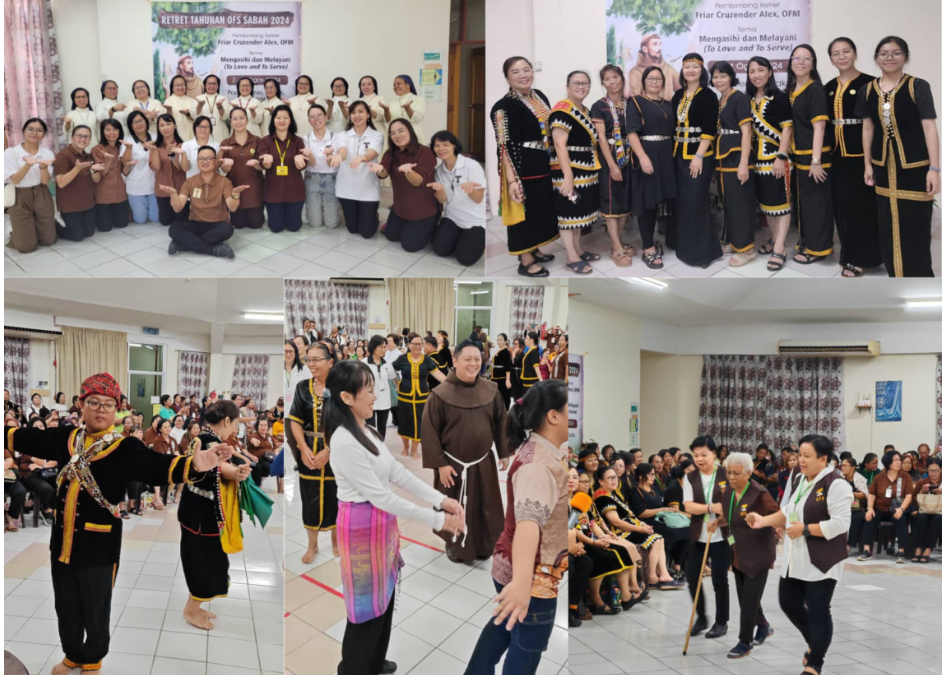
PACE BENE, Papar – Retret tahunan keluarga besar The Secular Franciscan Order (Latin: Ordo Franciscanus Saecularis; OFS) telah diadakan pada 2-4 Ogos bertemakan “Mengasihi dan Melayani” (To Love and To Serve) di Pace Bene, Papar.
Friar Cruzender Alex, OFM, selaku pembimbing retret dibantu oleh Sr Dariah Ajap, FSIC dan komiti penganjur bekerjasama dalam melancarkan perjalanan retret tersebut.
Retret tahunan itu dihadiri oleh perwakilan dari pelbagai paroki, walaupun dengan latar belakang yang berbeza, namun semangat dan sukacita jelas terpancar di wajah mereka. Ditambah lagi dengan penyertaan daripada seorang warga emas yang bertongkat dari kontinjen St Mary, Sandakan, telah menginspirasikan para ahli OFS untuk terus menghidupi persaudaraan dalam kalangan keluarga Fransiskan mahupun dengan alam semesta ciptaan Tuhan.
Berdasarkan tema tahunan, tiga soalan menjadi renungan peribadi para ahli; bagaimana saya dapat mengamalkan kerendahan hati dalam interaksi harian saya? Apakah tindakan kecil kasih dan pelayanan yang dapat saya masukkan dalam rutin harian saya? Bagaimana saya dapat lebih mendukung dan mengasihi saudara-saudari saya dalam Kristus?
Kemuncak kepada retret ini adalah acara Fransiskan Joy pada malam Sabtu di mana setiap kontinjen membuat persembahan pentas mengikut kreativiti masing-masing.
Suasana dewan menjadi hening seketika apabila tayangan video semasa lawatan kepada mangsa banjir di daerah Penampang dan aktiviti menghantar sumbangan makanan ke St Theresa of Infant Jesus, Kg Kolopis dimainkan.
Acara kemudian diteruskan dengan persembahan tarian mongigol dari etnik Rungus oleh kontinjenHoly Family Church, Telipok. Tidak ketinggalan, Friar Cruz juga telah membuat persembahan nyanyian duet bersama ahli OFS dari kontinjen Tuaran. Persembahan mereka mendapat tepukan gemuruh daripada ahli OFS yang pertama kali mendengar kelunakan suara Friar Cruz.
Retret diakhiri dengan sesi soal jawab dan ucapan daripada Marina Anjuman, National Minister OFS.
My name is Friar Gerald Tan OFM, and I am one of a handful of lay friars in the Franciscan order in Singapore.
In 2020, the year I made my solemn profession of religious vows, I discerned that the Lord was not calling me to the priestly ministry – in other words, not to become an ordained friar – at least, in this foreseeable season in my life as a fully-fledged Franciscan friar.
Choosing the path of becoming a non-ordained religious – what we call a lay friar or Franciscan brother – came to me as a surprise. It was as though the Lord threw a spanner in the works!
Earlier on my discernment journey, although I had been aware of the option of not moving into the ordained state in religious life, I did not understand why anyone would make such a decision and miss out on the “full package” of being ordained.
Being ordained a priest always seemed to be the default choice, since those who are not ordained undertake the same duration of seminary studies as those on the path to ordination.
Others felt it was a waste not to go “all the way”. At first, I believed this too, thinking ordination was the only option. I also feared that if I did not get ordained, I would be seen as lousier, lesser, or in the Singapore lingo, “CMI” (cannot make it).
But closer to my solemn profession, I realised that these “scripts” and socio-cultural beliefs were not at the core of my discernment. This was not about missing out, but instead, about a deep and personal call from the Lord Jesus, and through deeply knowing myself in responding to that call.
Later on, in my journey of formation and discernment, I realised that becoming a priest was just one of the expressions of ministry to God’s people as a Franciscan friar, as there are many other ways that a religious can be called to serve God’s people based on their personal gifts, talents, qualifications, and the needs of the community.
One key question I asked myself during my discernment was, “Do I have the stirring and desire to administer the sacraments?” To be honest, I did not.
I did, however, feel a growing desire to accompany and journey with others through their faith and personal struggles, especially through spiritual direction and other forms of individual and group accompaniment.
This desire to be available to others led me to minister to God’s people, without being an ordained minister of the Church, in four ways.
The first was through being formally trained in the ministry of spiritual direction, which I undertook in 2022. I regularly meet young adults for monthly spiritual direction sessions, and also direct individuals in their personal or silent retreats.
Secondly, I was appointed the local vocation director for the Franciscan Friars in Singapore. This allows me to journey with young men and to help them listen to and discern God’s will and vocational call for them, be it to the Franciscan order, or otherwise.
Thirdly, my theological and spiritual direction training allowed the Lord to use me to journey with young Catholic couples preparing for marriage within the Church.
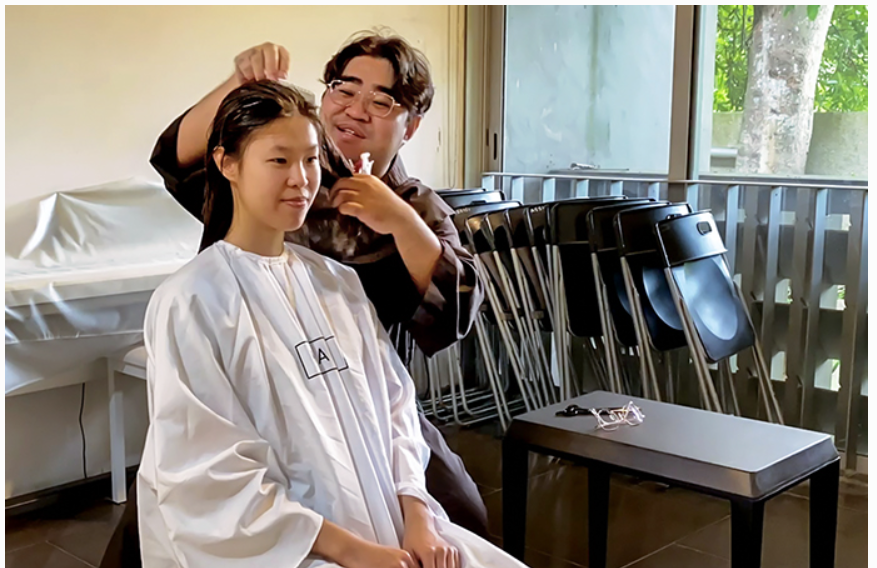
Finally, a unique way for me to minister to others was through hairstyling, after taking up haircutting courses for men and women.
The Lord inspired me to do this through a YouTube video documenting the ministry of a Friar-barber in America.
Applying this in the local context, I was able to merge the aspect of spiritual direction with the bond between hairstylist and regular patron.
This helped me to bring God into the everyday life of His people, providing a safe space and time for them to share whatever they wanted with me, while getting a nice haircut in the process!
“Behold, how good and how pleasant it is, when brothers live in unity!” (Ps 133:1)
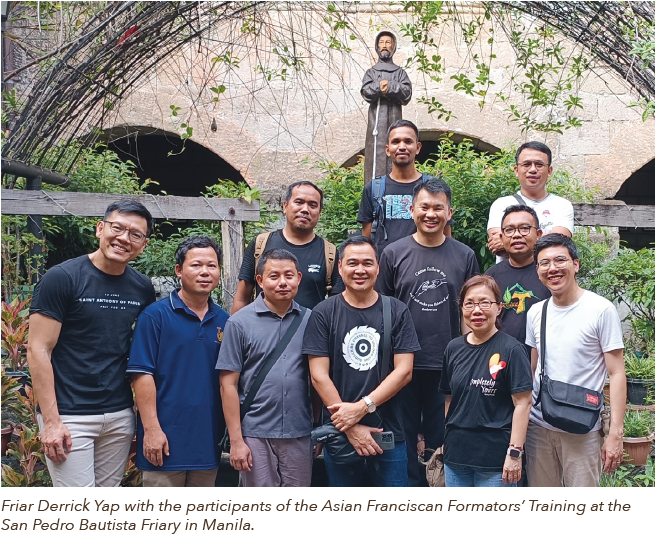
What more can you ask for when Franciscan friars from all over Asia come together and the conversations and care flow so naturally between them? That is what happened when the participants of the Asian Franciscan Formators’ Training (AFFT) gathered in Manila for the two-week Opening Residency Programme held from 16 to 29 June.
As programme coordinator, I watched this beautiful reality unfold with gratefulness and amazement. These eight friars from Indonesia, Myanmar, Malaysia, the Philippines, Sri Lanka and Vietnam had interacted for three months in Zoom tutorials and online forum discussions, but this was the first time the entire group had met in person. Two of the participants are from our very own Custody of St Anthony – Friar Aiden Peter and Friar Cosmas Francis.
The in-person gathering was planned as a time of fraternal bonding and mutual sharing because formation does not touch only the intellect. The formation of formators must touch the heart, where love abides. The raw material of our spiritual life is our personal experience of God, of love from our family and loved ones, and our experiences of joy, sadness, fear and anxiety. These emotions, whether positive or negative, must be embraced to properly discern our vocation as Franciscan consecrated persons.
The trainers for the two in-person modules – Group Facilitation and Empathic Listening – ensured that the participants had plenty of experiential learning. The friar participants took to these interactive activities easily and had much fun while doing so!
In the feedback session, the participants expressed gratitude for the time together and shared that they had found the fraternal connection very life-giving. They said that they felt more empowered to become better formators and were grateful to the benefactors and friends of the friars for their continued support and prayers.
On the Custody front, all our friars gathered at the beginning of July for a five-day retreat in Cameron Highlands with Friar Paul Rout OFM, an Australian Franciscan Philosopher teaching in the United Kingdom. The Custody friars have a retreat together every three years to connect deeply with God, and to talk about our spiritual lives and what connects us as Franciscans. This is imperative as our intimacy with God impacts our relationships with our fellow friars and the people we minister to.
In July, our two postulants, Jonathan Ng (Singapore) and Maximillian Alexson (Sarawak), had a unique opportunity during their seminary break for a pastoral exposure in another entity. They spent some time in the Cebu Province serving alongside the friars there in their various ministry outreaches to the poor and marginalised, and in inter-religious dialogue. Jonathan also spent some time in June with the Myanmarese refugees in Kuala Lumpur, and he shares his reflection on this experience in this issue of St Anthony’s Bread.
All in all, we are grateful to God for the many varied experiences and ministries we friars have. And we are always grateful to you, our benefactors and friends, for your continued trust in us to serve and encounter those whom God sends our way. Please continue to pray for us as we pray for you and your loved ones.
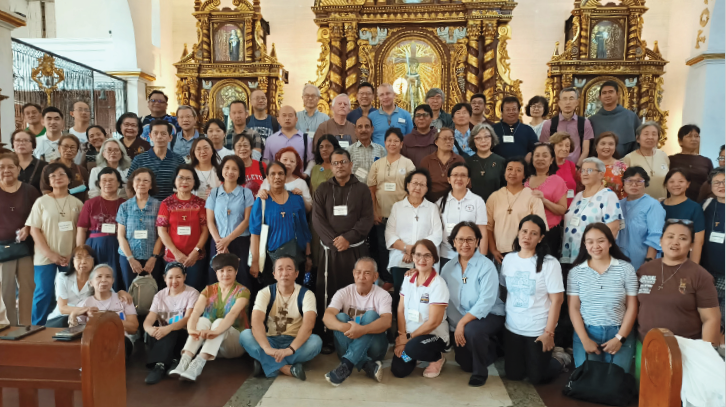
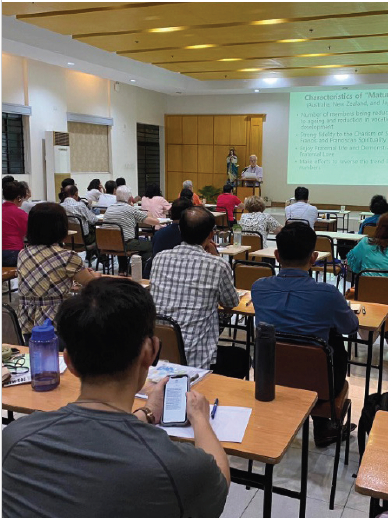
In May, Secular Franciscans from 12 countries gathered in Manila, the Philippines, for the five-day “Formation Course for Asia and Oceania”. The 38 Secular Franciscans, 12 Spiritual Assistants and 1 Franciscan Youth hailed from Australia, Hong Kong, Macau, Indonesia, Korea, Malaysia, New Zealand, Pakistan, Philippines, Singapore, Taiwan and Vietnam. The Singapore group was the largest with seven Secular Franciscans, accompanied by Friar Derrick Yap and Friar Vernon Chua.
Secular Franciscans are people who have responded to a call from God to follow the Gospel in the same way that St Francis of Assisi did in the context of our times. The Secular Franciscan Order (OFS) is an international Order within the Catholic Church with a Rule of Life and Constitutions that apply the Rule to daily life and circumstances. The OFS is a way of life where each member may find his or her apostolate according to the inspiration of the Holy Spirit. Each Fraternity in the Order must also find a common work to carry out the corporal and spiritual works of mercy.
A Secular Franciscan should not be defined by what he or she does but by what he or she must become: a reflection of Christ to the world in imitation of St Francis of Assisi. The formation course, held at Manresa Retreat House from 24 to 28 May 2024, sought to help the participants do this.
The course began on the afternoon of 24 May, with Mass followed by an update on the National Fraternities of Asia and Oceania by Augustine Yoon, a former Councillor of the International Council of the Secular Franciscan Order (CIOFS).
On 25 May, Friar Stefan Acatrinei OFM Conv, General Assistant of the Secular Franciscan Order, gave two lectures on the topic “The Wisdom of Love”, and Augustine Yoon gave a lecture on “A Thematic Guide for Formation”. Each country group presented a report on its OFS formation after which the participants broke into small groups for discussion before everyone gathered again to share the work done in groups. As true Franciscans, the day ended with a time of “Franciscan Joy” with singing, dancing, playing. It was a night filled with lots of laughter and happy faces.
On 26 May, Friar Stefan lectured on “The Franciscan Centenaries” and “The Service of Leadership in the Writings of St Francis and St Clare”, Grace Jose Garlene and Lucy Almiranez presented on “Fraternal Leadership: A Challenge and a Commitment”, and CIOFS Councillor Francis Park presented “CIOFS Communications – International Statutes”. After the work of the day, the participants were treated to an evening of Filipino cultural performance and food.
It was not all classroom presentations. On 27 May, the group went on a pilgrimage to the Shrine Basilica of San Pedro Bautista and visited Tagaytay City.
On the last day, the participants worked on a document summarising the sessions and resulting resolutions and recommendations. Once this was approved, they had a fraternal conversation with CIOFS Councillors Francis Park and Friar Stefan Acatrinei.
The course offered the participants the chance to get to know each other better, talk about the challenges of their national fraternities, exchange ideas and formation material and enjoy the beauty of being together as brothers and sisters in the great Franciscan Family.
As Jacqueline Low said, “It was an experience of connectedness with everyone. I felt a sense of connectedness even with creation, experiencing the essence of Franciscan fraternity and joy in one union with God amongst very diverse community and culture.”
While Margaret Goh shared, “I felt the challenges and resilience of our OFS brothers and sisters seeking to spread the Franciscan spirituality. We are encouraged to be more courageous to be seen as OFS in our parishes and among secular friends.”
It was an eye-opening experience for Victoria Voon, one of the four participants from Malaysia. “For me as an OFS Candidate, this was very good exposure to gain more knowledge, build good networking and get to know more OFS members from other countries,” she said.
In Singapore, the Secular Franciscan Order is an emerging National Fraternity of St Anthony of Padua with 30 Professed members in five canonically established fraternities. The National Fraternity is growing, with 27 currently in various stages of initial formation.
“I was drawn to become a Secular Franciscan through my exposure to the Franciscan way as some of my family members have joined the Secular Franciscan Order. The Secular Franciscan Order enabled me to live my vocation in a secular world, encouraging me to integrate my faith into my family, work and community life, thereby bringing the teaching of Jesus Christ into aspects of society,” said Monica Michael, Professed 2011.
Vivianne Kwong, who made her Solemn Profession in 2022, shared “What made me sure I wanted to be a Franciscan. … to be honest I was not sure. I needed a spirituality on which to live my life with. The Franciscan spirituality, the Franciscan joy tugged at my heart the most and on the day of my profession, after Friar Derrick ‘slapped’ me on the head, there was an instantaneous feeling that it felt right, and I knew I was home.”
For more information about the Secular Franciscan Order in Singapore, visit https://bit.ly/OFSintro.
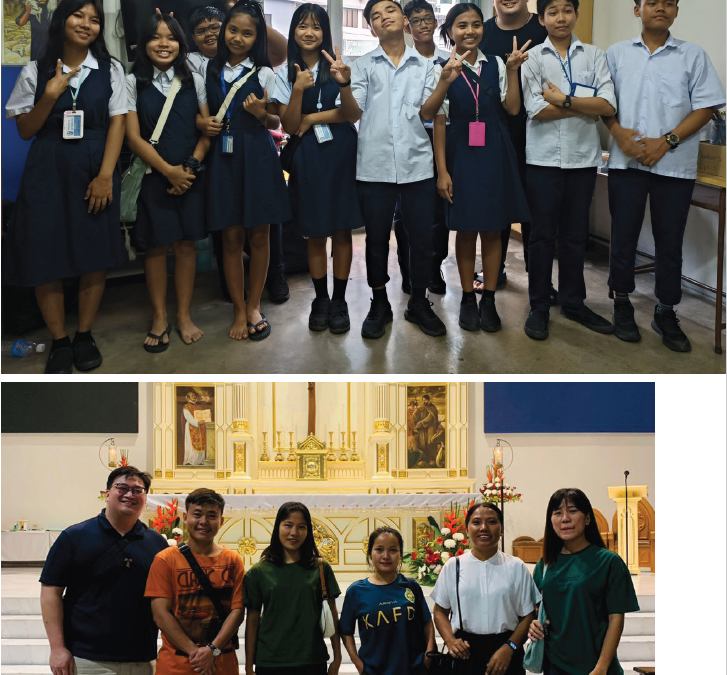
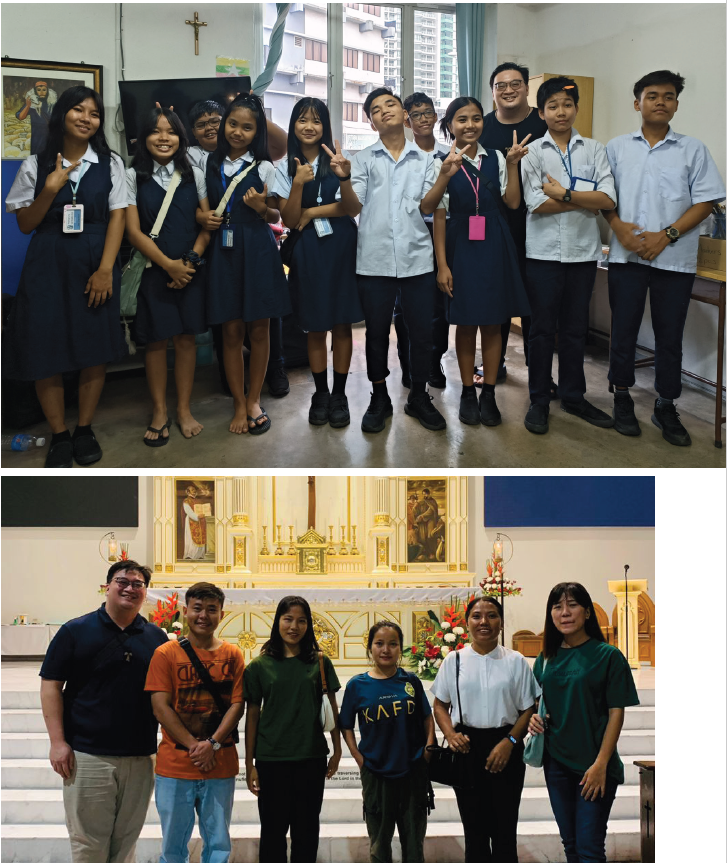
Jonathan Ng, one of two postulants in the Custody of St Anthony (Malaysia-Singapore-Brunei), spent the first three weeks in June on a mission trip to Kuala Lumpur, Malaysia. He shares his experience with us.
My mission trip in Kuala Lumpur from 1 to 21 June was working and living with refugees from Myanmar. I was assigned to two missions – a Catholic refugee learning centre and a refugee-focused clinic.
For most of the mission trip, I was attached to the refugee learning centre, which provides education to refugee children from nursery to primary five level. Most of the children were from Myanmar.
During my first week, many teachers fell sick with the flu, and I was “activated” to take over classes at various levels and made the stand-in form teacher for the Primary Five class. This was very much out of my comfort zone, as there was a language barrier. However, the children and I did our best to communicate, and the students shared freely and vulnerably about their struggles with their studies and their plight as refugees.
When they shared about their lives, at times there were frowns and sadness, but when they spoke about being in the school and being free from the challenges they face back home, smiles came quickly to their faces. I see this as gladness and joy that only God grants.
In the last week of my mission trip, I was attached to the ACTS clinic. Refugees of all nationalities are welcome there, but most of the patients are refugees from Myanmar. The clinic offers a flat rate to patients for consultation and medication.
Following Dr Caroline Gunn from ACTS clinic, I heard the stories of some of the patients –the challenges they faced in moving to Malaysia, and how they are coping.
Reflecting on my mission trip, I remember especially the time I spent living and working with the teachers at the refugee learning centre. They truly have the biggest hearts caring for the students, and unbeknownst to them, they have shown me God’s love.
Nehemiah 8:10 says “… do not be grieved, for the joy of the Lord is your strength”. It was there, being with them that the truth of “the joy of the Lord is my strength” was made so tangible. Despite their circumstances, the faces of these refugees, both young and old, were constantly lit with joy. This experience and the people that God has allowed me to meet will stay ever so close to my heart and prayers.
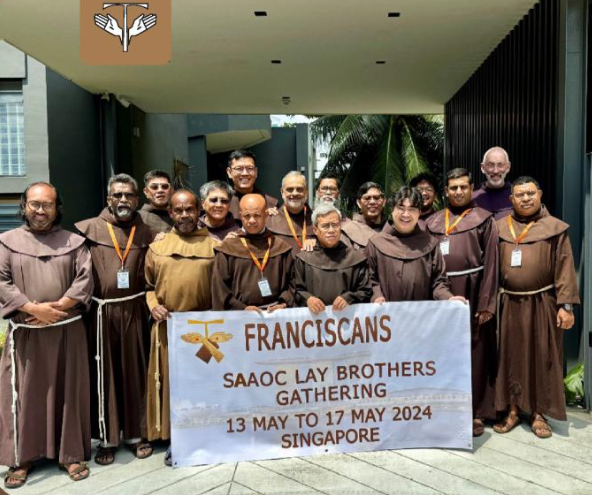
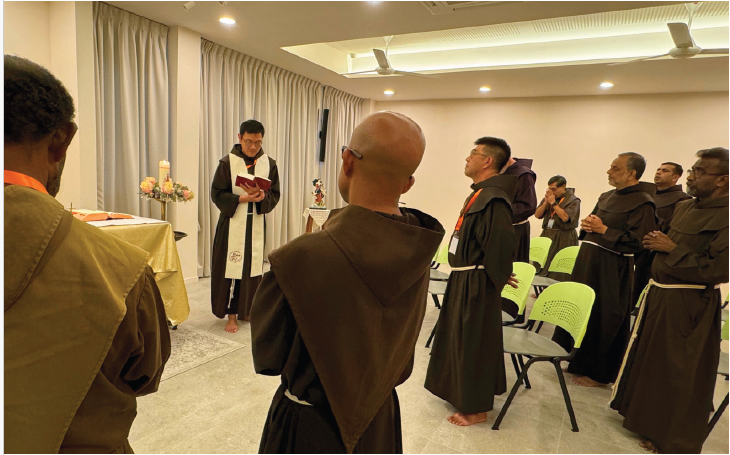
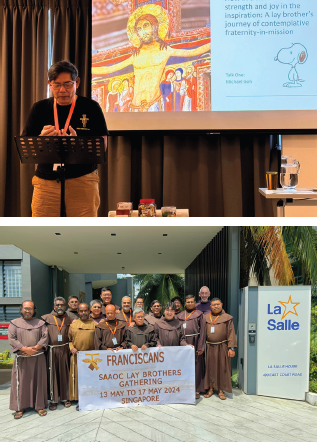
In May, the Custody of St Anthony (Malaysia-Singapore-Brunei) hosted a regional meeting of Lay Friars within the South Asia, Australia and Oceania Conference (SAAOC).
In the Franciscan Order, as in the Church, a baptised person falls under one of two states: Lay (non-ordained) or Clergy (ordained). Thus, if a friar, through his discernment, does not move toward ordination to the clerical state as a deacon or priest, he is a Lay Friar, commonly called a “Franciscan Brother”. A friar who undertakes the Sacrament of Holy Orders through ordination is known as an Ordained Friar or Friar-Priest.
In 2022, the OFM General Chapter resolved that each international conference of friars would hold regional/international conference meetings of Lay Friars to prepare for the international meeting of Franciscan Lay Friars to be held in 2025.
Accordingly, 15 Lay Friars from Australia, India, Indonesia, Malaysia, Singapore, Sri Lanka, Timor-Leste and West Papua gathered at La Salle House in Singapore for five days of discussion and fraternal bonding. The theme for the meeting was “Renewing Our Common Vision as Lay Friars in a Fractured World: Franciscan Contemplatives Formed for Pastoral Ministry and Evangelisation.”
Minister General Friar Massimo Fusarelli OFM set the tone for the gathering with a very encouraging letter to all gathered. In it, he exhorted the friars to deepen their identity as brothers and minors, and to also be very daring to welcome back the diversity and completeness of our (Franciscan) vocation.
“If the Lay Friars become very few or even die out, the provincial fraternities would lack an essential element of the (Franciscan) charism,” he wrote, before inviting the Lay Friars into critical reflection with recommendations for bolstering the vocational path of being a Lay Friar within the Franciscan Order.
There are only about 1,600 Solemnly Professed Lay Friars out of approximately 10,000 Solemnly Professed Friars around the world, at last count in 2022. The rest (an estimated 8,400) are Ordained Friars.
The meeting, held from 13 to 17 May 2024, was facilitated by Friar David Leary OFM, a Lay Friar-Psychologist, Professor and Counsellor engaged in social work services in Australia. The main topics for presentation, reflection and discussion were Contemplation, Formation, Pastoral Ministry and Evangelisation.
There was great richness in the sharing and discussion. The group noted that although the ministries of Lay Friars are significantly less visible to the public, and even to fellow members of the Franciscan fraternity, they are immensely important and impactful in the lives of the individuals to whom the Lay Friars minister. Lay Friars work in many areas including counselling, spiritual direction, nursing, teaching, social work, institutional management and the formation of friars and lay people, recognising that God’s call to minister to His people is not limited to the sacramental ministry of the ordained (Friar-Priests).