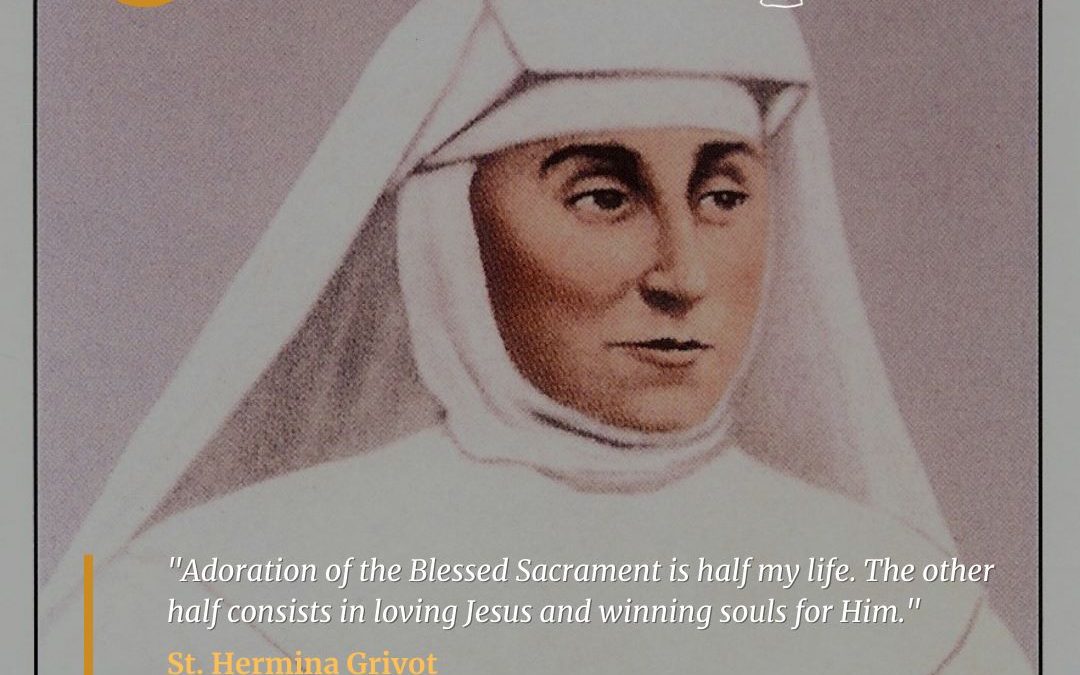
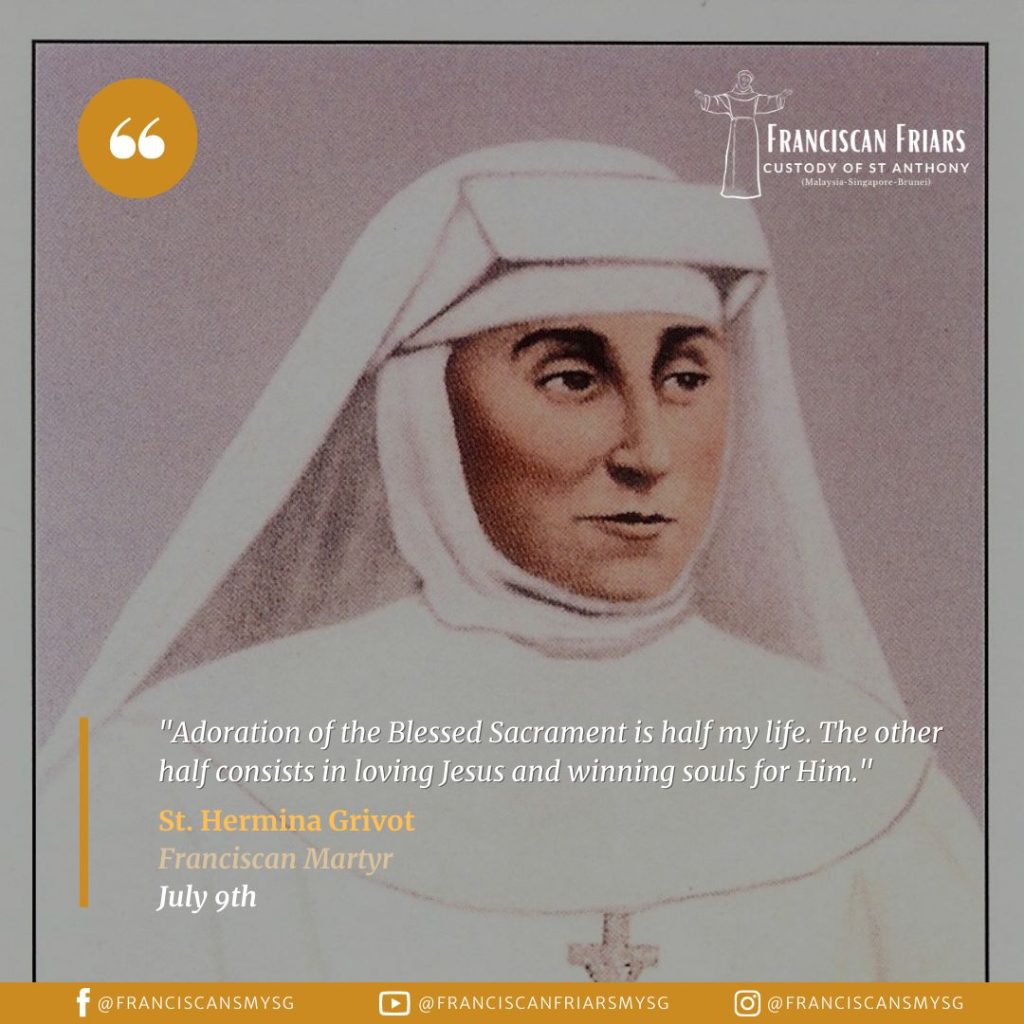
As a young woman in Burgundy, Hermina Grivot joined a missionary congregation, the Franciscan Sisters of Mary, hoping to be sent overseas, praying for the grace to become a saint, worrying only that the time of martyrdom had probably passed.
In 1898, the missionary bishop of Shanxi province asked her community for a contingent of sisters to staff an orphanage and dispensary in Taiyuan, China. Grivot was happy to be put in charge of this mission. The next year, she and her sisters embarked on the long and arduous journey to China. They were ill-prepared for what faced them – knowing not a word of Chinese, and having no particular training in education or nursing. Even the priests in the mission did not speak the language, but relied on translators. Nevertheless, they all energetically rose to meet the enormous challenges at hand.
As it turned out, they had arrived at a perilous time. Rising nationalist resentments over foreign exploitation were about to ignite in the Boxer Rebellion of 1900. The uprising targeted Europeans and Chinese converts to Christianity – Christianity being seen by many Chinese a tool of colonialism.
On July 9, a large number of Franciscan missionary in Taiyuan, including Bishop Gregory Grassi and the entire cohort of sisters, were arrested. Grassi urged the sisters to dress in Chinese clothes, but they refused: “Don’t stop us from dying with you,” they replied. They were all beheaded, Sister Hermina among them. She was canonized in 2000.
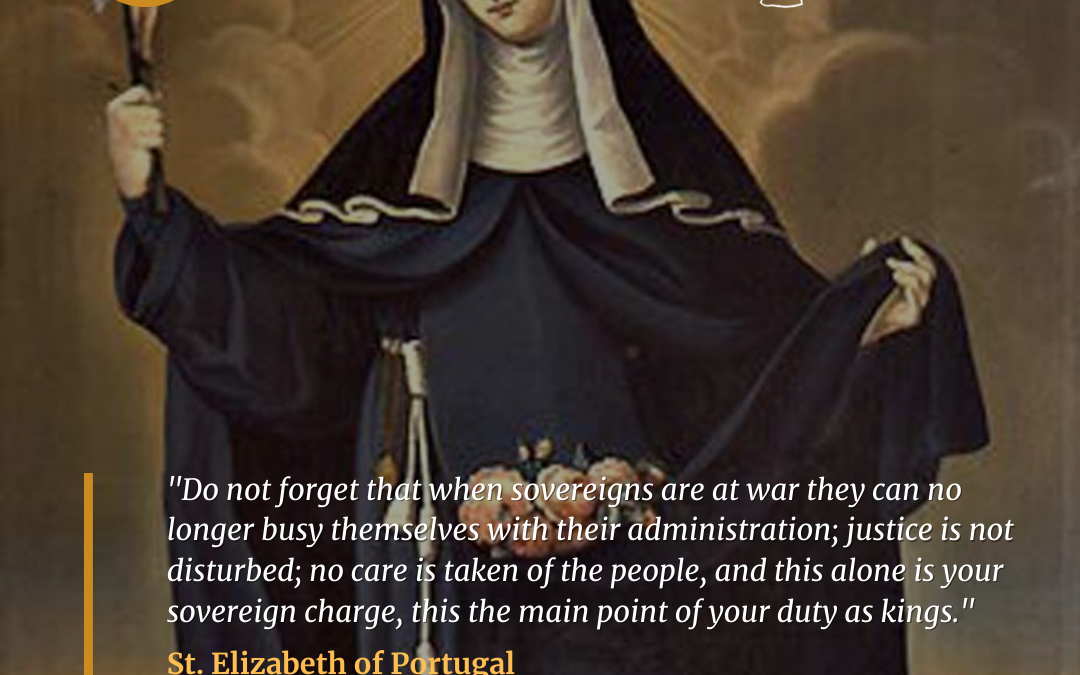
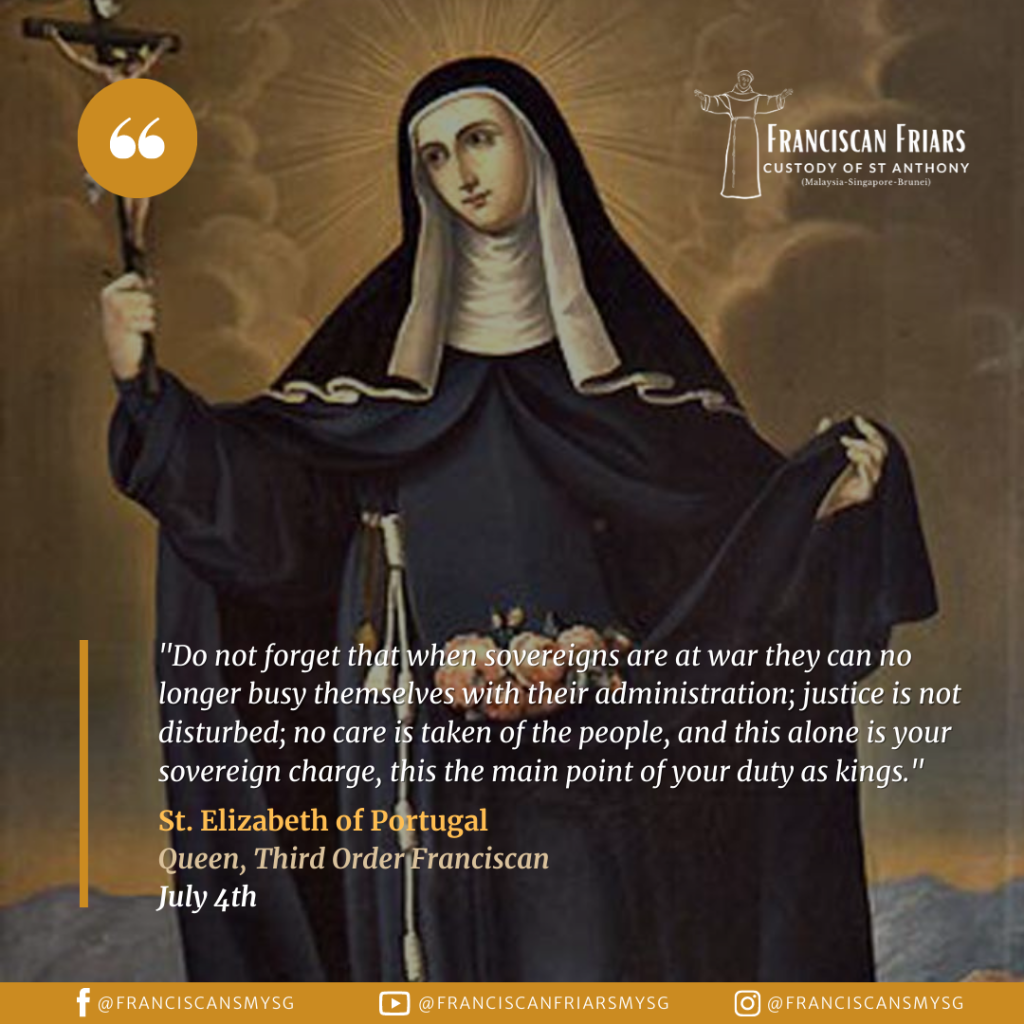
St. Elizabeth of Portugal was the daughter of the king of Aragon. At twelve, she married King Denis of Portugal, a profligate man, who tolerated his wife’s piety while making no secret of his own infidelities. Elizabeth bore him two children, a son and a daughter. Her son, Alfonso, would later come close to open rebellion against his neglectful father. For her role in effecting a reconciliation between father and son, Elizabeth became popularly known as “the Peacemaker.” But her peacemaking talents were exercised on an even greater level when she personally prevented a war between Portugal and Castile.
Elizabeth lived up to her public responsibilities as queen. But the greater part of her time was spent in prayer and a variety of charitable projects. She established hospitals, orphanages, and religious houses throughout the kingdom, as well as halfway homes for “fallen women.” “God made me queen so that I may serve others,” she noted.
When her husband died, she put on the habit of Franciscan tertiary and lived for her eleven remaining years in one of the monasteries she had helped to found. She emerged occasionally to intercede between rival monarchs – with most of whom she bore some relation. Even as she lived she was credited with miracles, and she was revered by the people of Portugal.
Elizabeth died in 1336 and was canonized three centuries later by Pope Urban VIII, who named her the Patroness of Peace.
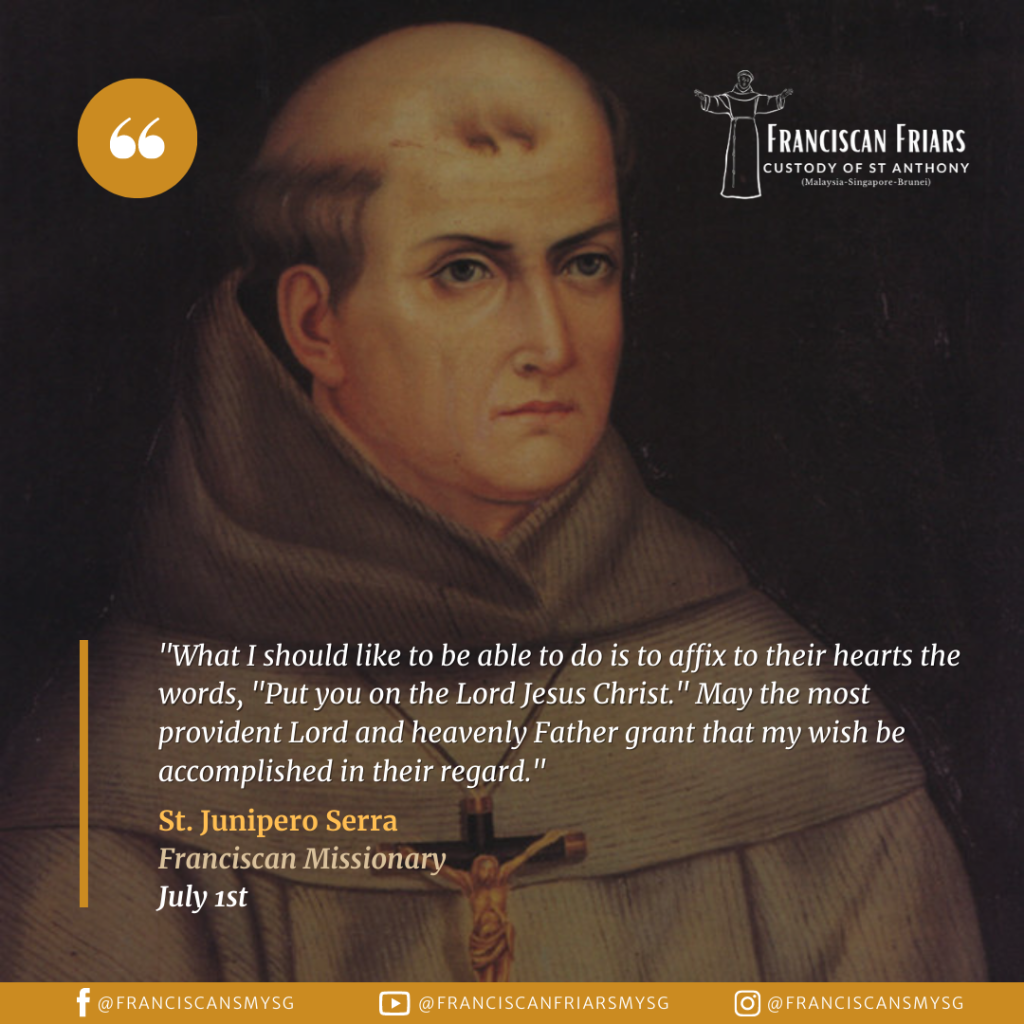
Junipero Serra is celebrated as one of the fathers of California. Born in Majorca, Serra entered the Franciscan order at sixteen. After earning a doctorate in theology, he taught as a professor for many years before volunteering for the missions in New Spain. He spent twenty years in Mexico, then travelled by foot to California, where he spent the rest of his life. From his arrival in 1769, when he founded the mission of San Diego, until his death fifteen years later, he tirelessly travelled the length of California, established nine missions, and baptized many thousands of Indians.
Serra espoused an austere, ascetic brand of Catholicism. In preaching, he was capable of demonstrating his zeal by striking his breast with a stone, or holding a lighted torch against his chest to demonstrate the fires of hell.
His canonization in 2015 – the first to take place in North American soil – was not without controversy. Critics, including many Native Americans, raised questions about the mission settlements in which Indian converts were incorporated, becoming virtual prisoners or indentured servants. Others defended Serra and the Franciscan missionaries for protecting the Indians from harsher abuse by the secular authorities.
Serra died on August 28, 1784. He is buried in the sanctuary floor of the Mission de San Carlos Borromeo in Carmel.
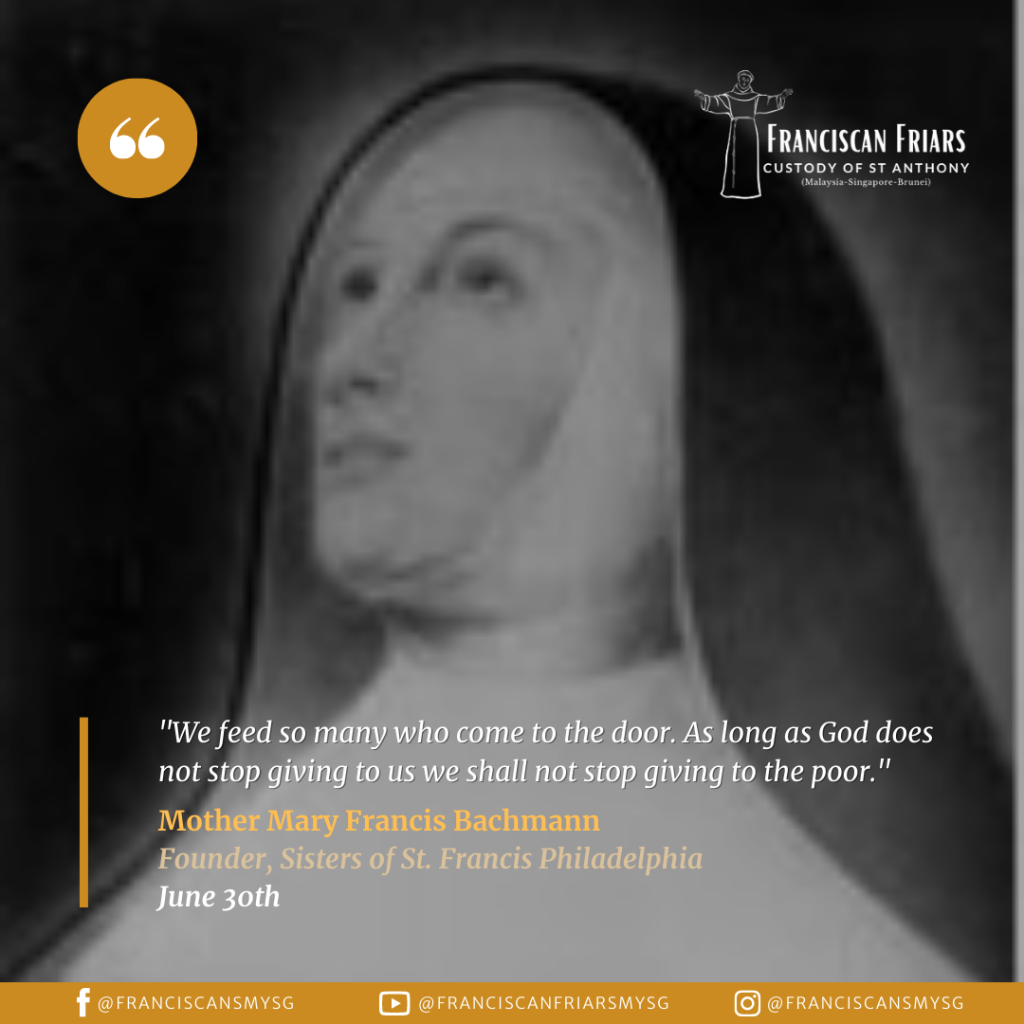
Anna Maria Boll Bachmann, who was born in Bavaria, immigrated to the United States and settled in Philadelphia. In 1851, when her husband Anthony was killed in an accident in a stone quarry, she found herself a widow with three young children and a fourth on the way. To support herself, she and her sister opened a small hostel for immigrant women. In time, they conceived the idea of joining a religious community. Their confessor, a Redemptorist priest, encouraged them in the direction of the Third Order Franciscans and wrote to Bishop John Neumann, then in Rome, on their behalf. This overture was well timed. Bishop Neumann had been seeking help from the pope in securing German Dominican sisters to help in his diocese. But the pope had encouraged him instead to start a local Franciscan community. Thus, on his return, he provided instruction to Anna, her sister, and another woman who had joined them, and accepted them into religious life. In 1855, the Franciscan Sisters of Philadelphia was established, with Anna, now Mother Mary Francis, as superior.
The sisters supported themselves by sewing and alms, while initially caring for immigrant women. Eventually, Bishop Neumann steered them into wider ministries: a school, an orphanage, and even a hospital for the sick poor. The latter undertaking followed their work in caring for the poor during an outbreak of smallpox, when no other hospital in the city would accept patients with contagious diseases.
Mother Mary Francis died of tuberculosis on June 30, 1863.
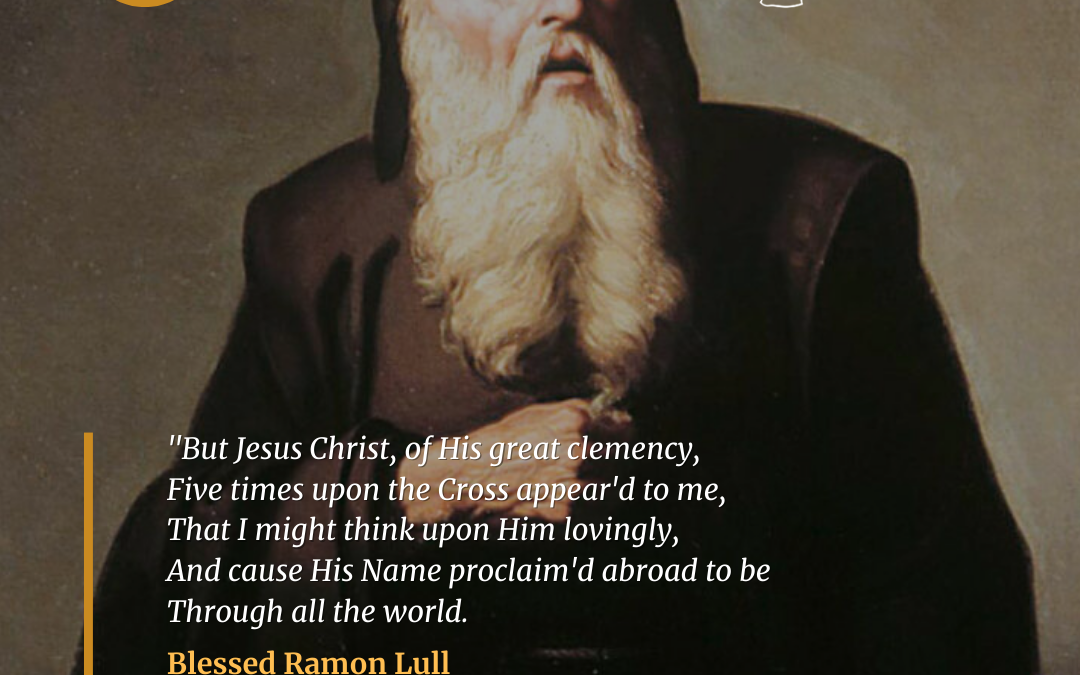
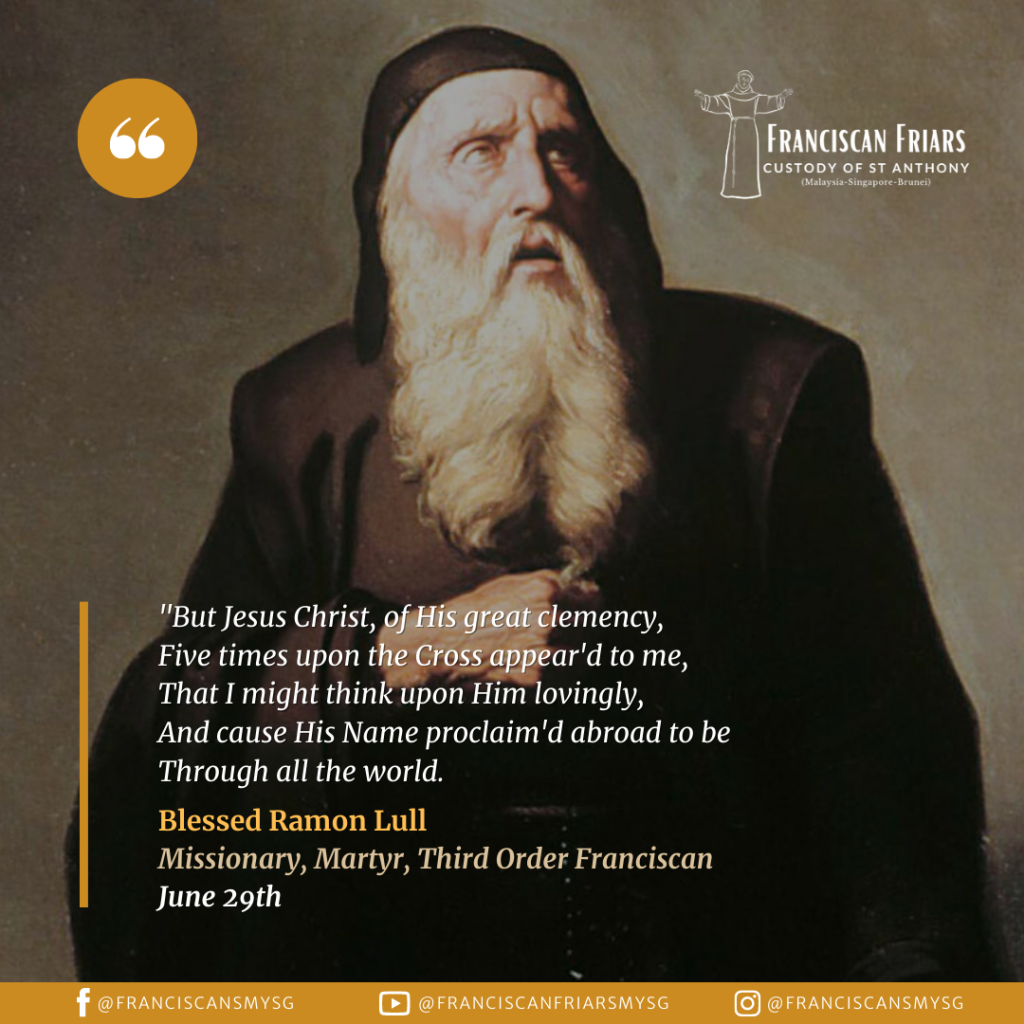
Ramon Lull was born in Majorca in 1232, the son of a Catalan military chief. His early life was spent in the frivolity of court life. At the age of thirty, however, prompted by a recurrent vision of Jesus on the cross, he underwent a dramatic and total conversion. Afterward, he gave up all his property to his family and the poor and determined to devote his life to God’s cause. In particular, he felt called to bring the Gospel to the Muslims – a vocation, he was sure, that would cost him his life.
He prepared for this mission with zeal. For over a decade he pursued studies in Latin and Arabic and immersed himself – to a remarkable degree – in the literature of Muslim religion and philosophy. He believed that a missionary must be fully knowledgeable about the beliefs of those he wished to convert.
At this point, the primary locus of Christian-Muslim encounter had been the battlefields of the Crusades. To most Christians of Lull’s day, the Muslims were irredeemable heretics whose slaughter brought glory to God. The Crusades were not even ostensibly concerned with the conversion of Muslims; their object was simply to drive the ‘infidels’ from the Holy Land, a sacred cause that justified any means. (A bright exception was St. Francis of Assisi.)
At sixty, Lull himself became a Franciscan tertiary. His vision never advanced so far as to reject all recourse to force in the service of the Gospel. But in his respect for the intelligence and good faith of non-Christians and his belief in the need to encounter them on their own terms he introduced a remarkably progressive path for this time.
Lull travelled throughout Europe lobbying and seeking sponsors for his projects, which included a series of missionary colleges where the best preachers of the world could study the languages and cultures of the non-Christians world. Such plans came to naught. He also wrote several hundred major works, as well as mystical poetry and allegorical romances about the Christian life. A Christian troubadour in the Franciscan mold, he has been called “the Catalan Dante.”
Lull made three trips to North Africa. On the first and second occasions, he was quickly arrested and deported. However, on his third trip in Tunisia he was accosted by a mob on June 29, 1316, and stoned to death. He had foreseen this fate from the outset of his vocation. As he wrote, “Missionaries will convert the world by preaching, but also through the shedding of tears and blood and with great labor, and through a bitter death.”