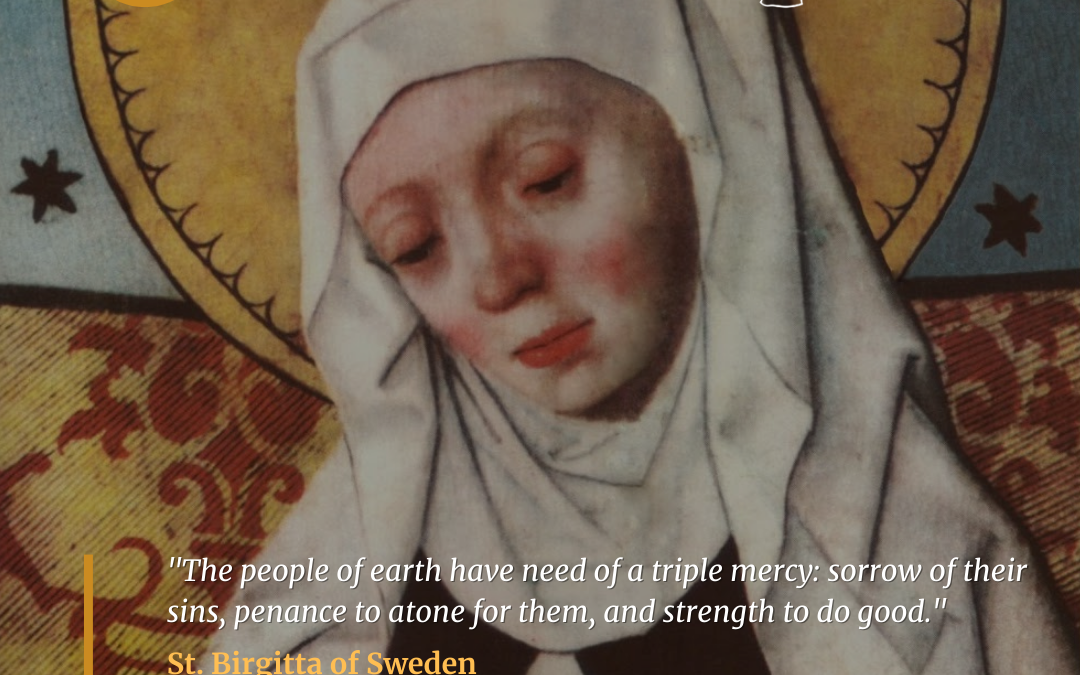
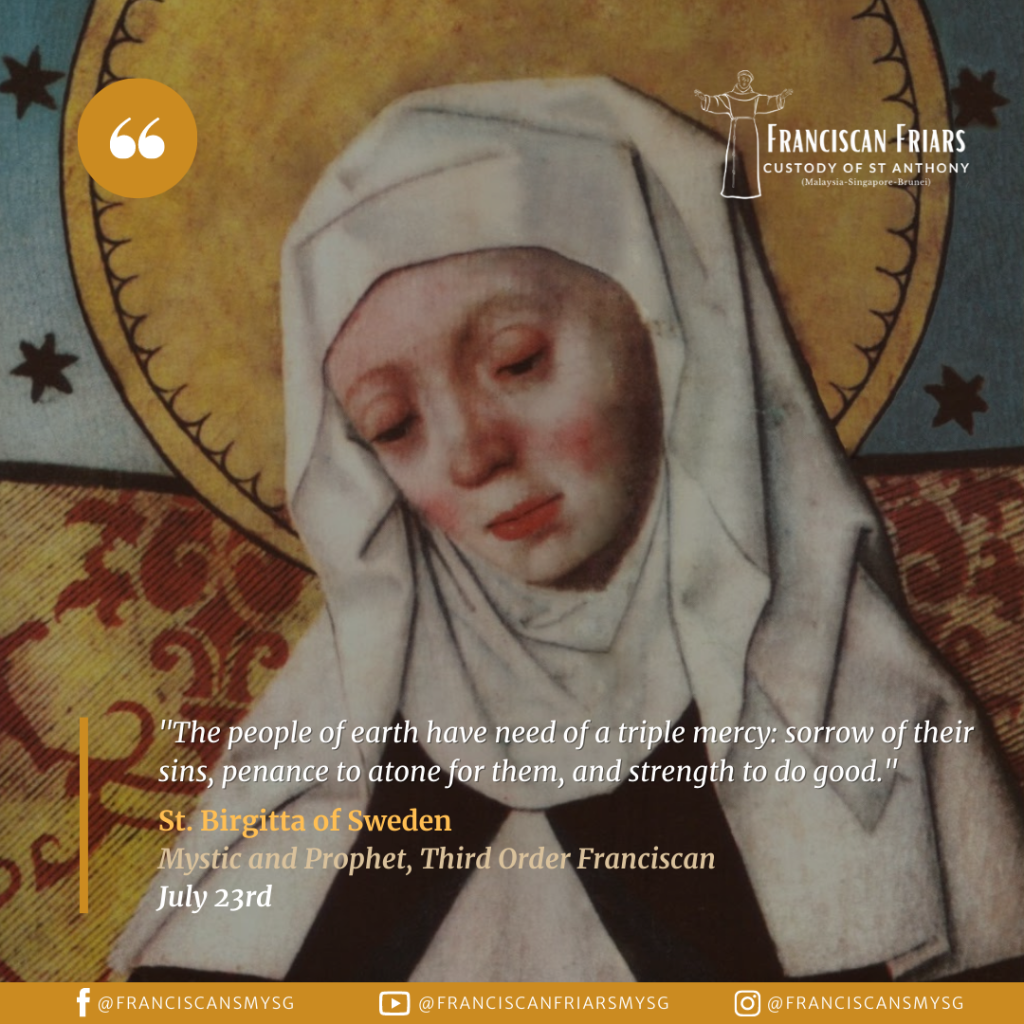
St. Birgitta of Sweden was one of the great women of the fourteenth century: the wife of a nobleman and the mother of eight children; a nun and founder of monasteries as well as a religious order; a pilgrim who crossed continents and seas; a mystic who filled many volumes with accounts of her visions and colloquies with Christ; and a prophet who called kings to justice and popes to live up to their sacred duties.
She experienced her first vision as a child, when she saw an altar, and seated above it a woman who said, “Come, Birgitta,” and offered her a crown. Some years later she had another vision of Christ hanging on the cross. When she asked him who had treated him this way, he answered, “They who despise me and spurn my love for them.” From that point, she felt herself mystically united with Christ and determined to serve him in every way.
At fourteen, she married a prince named Ulf. It was a happy marriage that lasted twenty-eight years. Whenever she could, she would visit the hospitals, binding the wounds of the patients with her own hands. She often brought along her young children, desiring that they learn “at an early age to serve God and his poor and sick.” Eventually, fed up with the frivolity of court life, both she and Ulf embarked on a long pilgrimage that took them all the way to Compostela in Spain. On the return trip, Ulf died, and Birgitta sought consolation in becoming a member of the Third Order of St. Francis.
Before long, she received another vision, this time instructing her to found a monastery in Sweden. After she had accomplished this, she went on yet another pilgrimage to the Holy Land, where she again received many visions of the events of Christ’s life, before finally settling in Rome for the last twenty years of her life. Wherever she traveled, she spoke out against slavery, injustice, and threats to peace. Confronting the corruption she encountered in the Eternal City, she cried out, “O Rome, Rome, be converted and turn to the Lord thy God.” She excoriated the pope for abandoning Rome for Avignon, and at one point even denounced him as “a murderer of souls, worse than Lucifer, more unjust than Pilate, more merciless than Judas.” Despite her frankness, he approved the rule of her new order, the Birgittines.
St. Birgitta died on July 12, 1373. A triumphal procession, led by her daughter, accompanied her body across Europe and back to her abbey in Vadstena, where she was laid to rest.
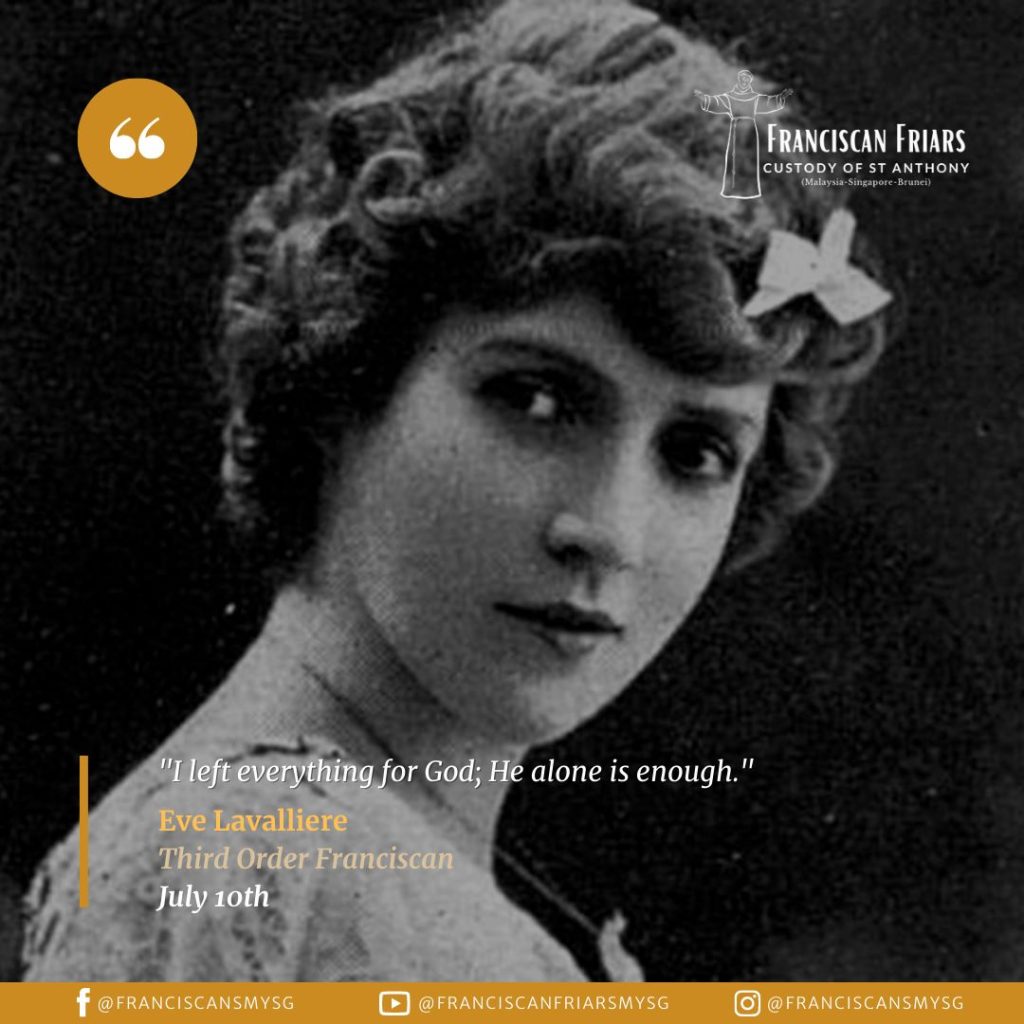
For years, Eve Lavalliere was the toast of Parisian society, a famous beauty and the most popular actress on the French stage. While performing for royalty across Europe, she enjoyed the favors of numerous lovers. “I had everything the world could offer,” she noted, everything I could desire. Nevertheless, I regarded myself as the unhappiest of souls.” Unhappiness ran deep in life. Her abominable childhood had ended the day her father, in a drunken rage, shot her mother and then killed himself. Her later fame and wealth could not fill the void.
And yet Eve’s life took a dramatic turn 1917 when a priest gave her a biography of Mary Magdalen and challenged her to read it. At first defiantly, and then with tears of remorse, she read the book, and when she had finished she resolved to make her peace with God.
“My resolution is made. From now on, only Jesus has a right to my life, for He alone gave me happiness and peace.”
Abandoning her glittering life, Eve first sought to enter religious life, but she was rejected by a number of convents on account of her notoriety. Instead, she became a Third Order Franciscan. For several years, until ill health overtook her, she volunteered with a lay-missionary nursing order in Tunisia. She spent her last year alone, penniless, and in great suffering. Yet she insisted she was the “happiest person in the world.” In her notebook she wrote,
“I thank You, O my God, that You have given me shelter beneath your roof. Abandonment, love, trust – such is my motto.”
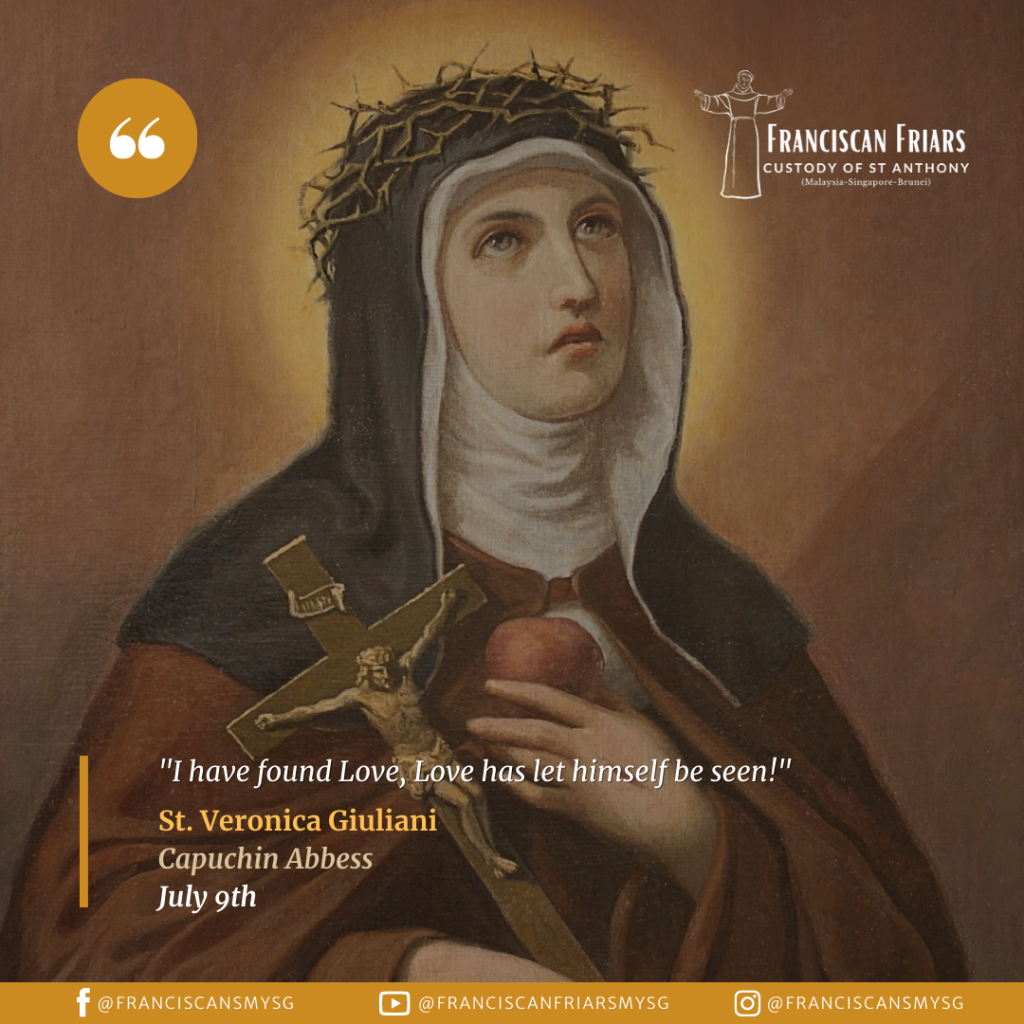
Ursula Giuliani was born in the small Italian town of Mercatello. At the age of seventeen, after receiving a vision of the Blessed Mother, she entered the Capuchin convent of Citta di Castello in Umbria, and took the name Veronica. Early in her religious life, she began to experience an extraordinary identification with the Passion of Christ. In 1694, she displayed on her forehead the imprint of the crown of thorns. In one vision, she saw the crucified Christ remove his arm from the cross and beckon to embrace her by his side. As she felt an arrow pierce her heart and received on her body the wounds of the crucifixion, she wrote,
“I felt great pain but in the same pain I saw myself, I felt myself, totally transformed into God.”
Veronica’s physical wounds were examined and treated by medical professionals, with no effect. After a personal examination by the bishop, he ordered that her hands be covered in gloves and sealed with his personal seal. She was to be deprived of the Eucharist, kept away from the other nuns, and subjected to constant supervision. But when her signs nevertheless continued, she was allowed to resume her regular life.
Despite her extraordinary mystical gifts, there was nothing unbalanced about Veronica’s religious life. She served for thirty years as novice mistress and spent her last ten years as abbess of her convent. She died on July 9, 1727, and was canonized in 1839.
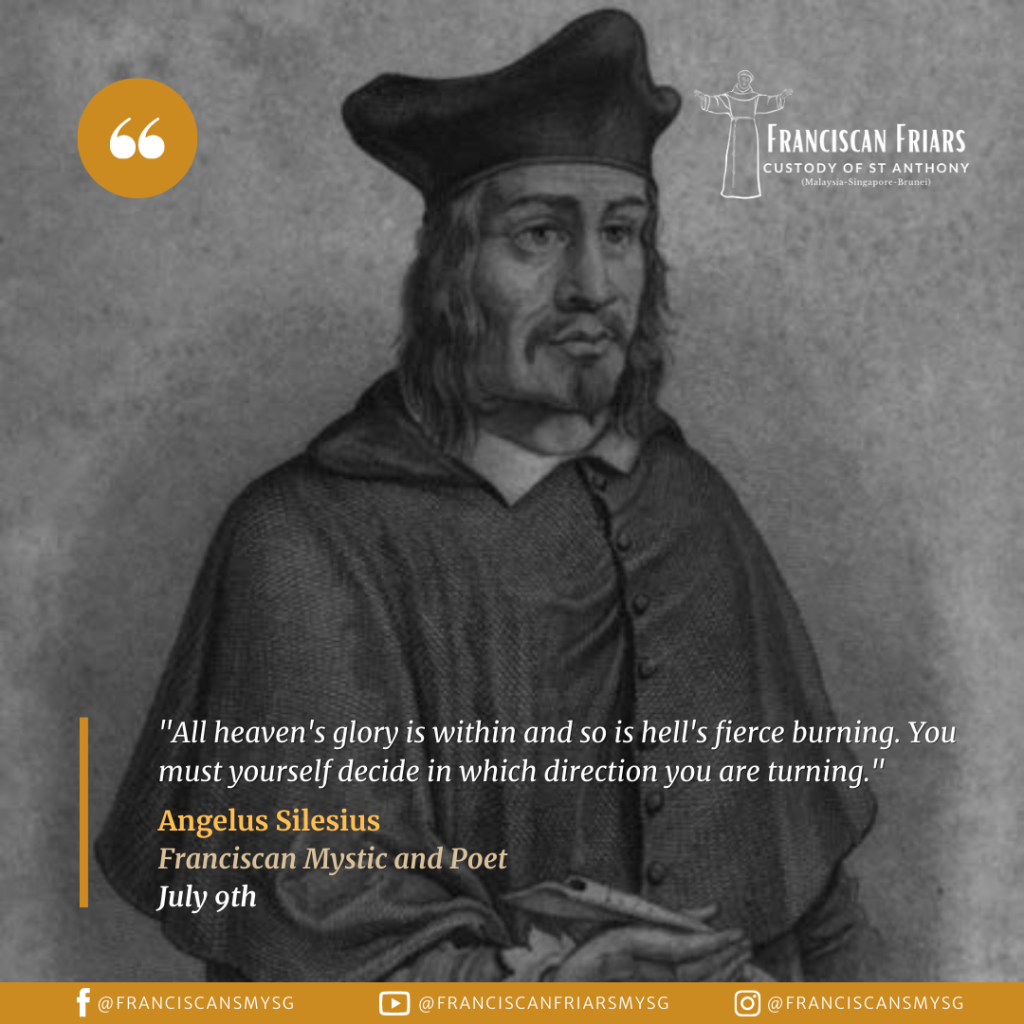
Johann Scheffler (his given name), was born to a Protestant parents in Breslau, the capital of Silesia. After earning a doctorate in medicine, he served as court physician to Count Sylvius Nymrod, an ardent Lutheran. Over time, his public questioning of Lutheran doctrine and his increasingly mystical learnings caused him to be viewed with suspicion. In 1653, he resigned from his position, converted to Catholicism, and took the name Angelus Silesius. After joining the Franciscans, he was ordained a priest.
Silesius is best remembered for his two volumes of mystical poetry, The Soul’s Spiritual Delight and The Cherubic Pilgrim. Many of his poems consist of epigrammatic rhyming couplets – many later adapted by both Catholic and Protestant hymnists. Silesius was fascinated by the relation between God and creation, the divine and the soul:
A Loaf holds many grains of corn
And many myriad drops the Sea:
So is God’s Oneness Multitude
And that great Multitude are we.
His ability to detect God’s presence in all things caused some to accuse him of pantheism. But he did not worship nature. Instead, he saw in all creation the overflowing of divine love and energy and believed that the same energy and love was drawing all things toward final reunion with God.
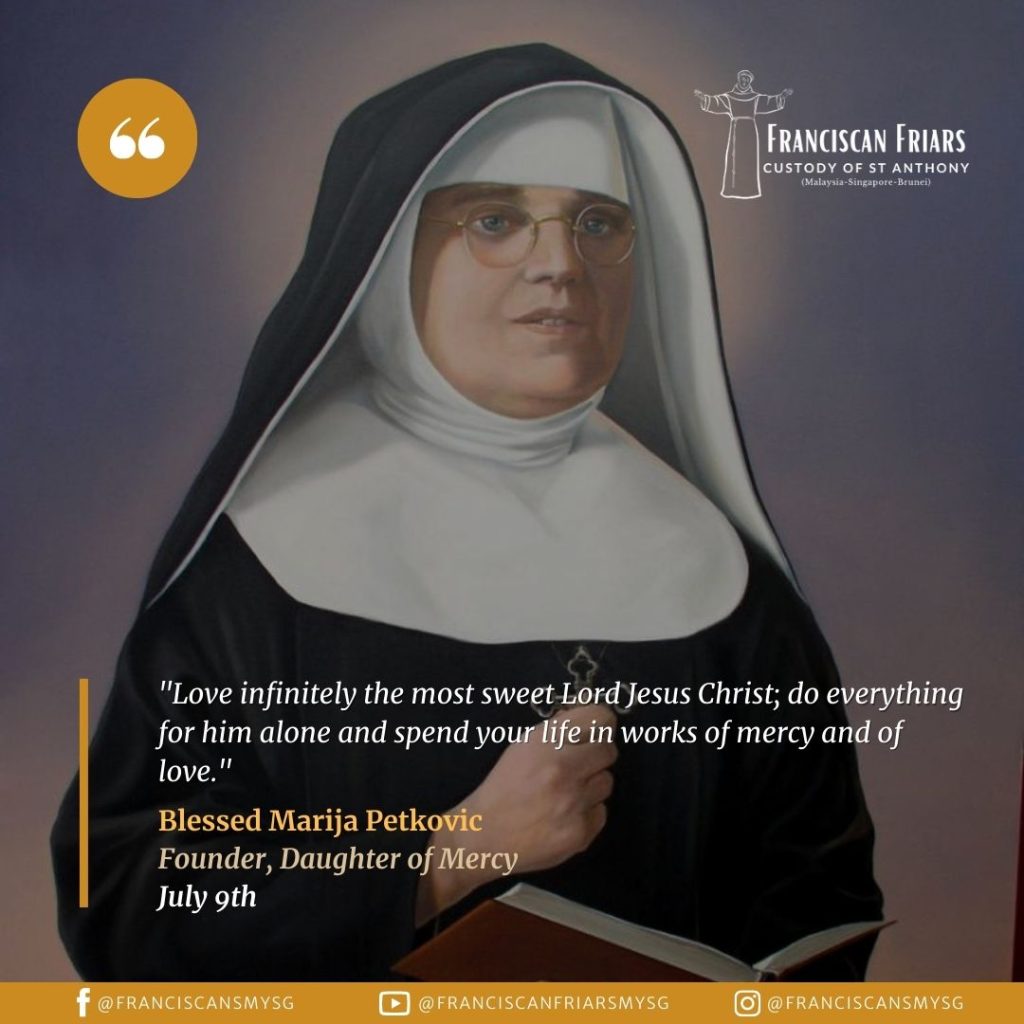
Marija Petkovic was born to a poor family in southern Croatia. Committed to serving the poor, she entered a local convent of the Servants of Charity. Many of the sisters were Italian, and when, following the death of their superior, most of them decided to return to Italy, Marija was appointed by the bishop to serve as the new superior. He told her this meant being “the last among the Sisters, and if necessary going barefoot while the Sisters wore shoes…following the example of the crucified Jesus.”
In 1920, she reestablished her community as a new congregation, the Daughters of Mercy, an independent Franciscan congregation with the mission of spreading knowledge of the love of God through performance of the works of mercy. She took the name Mary of Jesus Crucified.
Over time, she established forty-six communities, including several in Argentina. Her connection to Latin America contributed to the unusual miracle that was certified in approval of her beatification. In 1988, a trawler in the South Pacific crashed into a Peruvian submarine, which began to sink. An officer on board the submarine invoked the help of Marija Petkovic and reportedly received the strength to open a hatch against thousands of pounds of water pressure, allowing his crewmates to escape.
Marija Petkovic died on July 9, 1699. She was beatified in 2003.