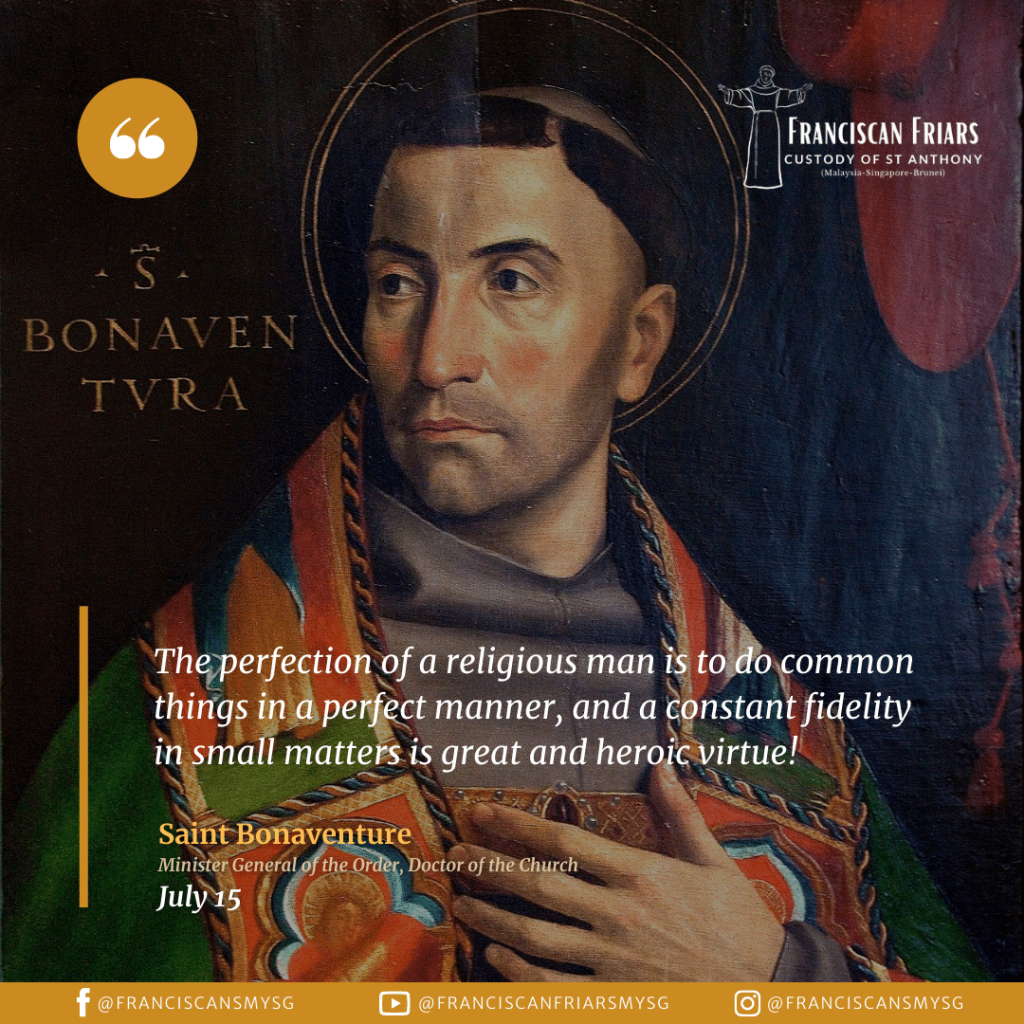
Bonaventure, who was born to a wealthy family in Orvieto, joined the Franciscans around 1238 in the midst of his studies at the University of Paris. St. Francis had died only some dozen years before, but already his order was rapidly changing the face of the Church in Europe. To Bonaventure, it seemed that the Franciscan Order “was not invented by human providence but by Christ. In it, the learned and the simple lived as brethren.”
Bonaventure himself was definitely one of the learned. Franciscan simplicity might not have seemed an attractive fit for such a scholar. In fact, Francis had held learning in great esteem so long as it was subordinated to the pursuit of holiness. In this spirit, Bonaventure received support from the Order to continue his studies. In 1257, along with his Dominican counterpart, St. Thomas Aquinas, he received his doctorate in theology.
Rather than pursue the life of an academic theologian, however, Bonaventure was immediately elected to serve as minister-general of the Friars Minor—a role in which he left a lasting mark. During a time of contending factions within the order, Bonaventure tried deftly to steer a middle course between the radical freedom of Francis and the disciplined order of a religious community. To reinforce his moderate interpretation of the Franciscan charism, he composed an influential life of St. Francis. For his successful efforts, he would become known as the Second Founder.
“The perfection of a religious man is to do common things in a perfect manner, and a constant fidelity in small matters is great and heroic virtue!”
– St. Bonaventure
He wrote a number of other important works, including his mystical treatise The Journey of the Mind to God. This was his attempt to translate Francis’s identification with Christ into philosophical terms—a journey of the soul along the path of holiness, leading from contemplation of the created world to an ever-deepening contemplation of the spiritual order, and progressing ultimately toward the goal of union with God.
In 1265, Bonaventure respectfully declined an appointment as archbishop of York. In 1273, however, Pope Gregory X ordered him to accept the title of cardinal-bishop of Albano. When papal legates arrived to present him with his red hat and insignia of office, he kept them waiting while he finished washing the dishes. Summarizing his spirituality, he observed: “The perfection of a religious man is to do common things in a perfect manner, and a constant fidelity in small matters is great and heroic virtue!”
Bonaventure died in 1274. He was canonized in 1482 and later declared a Doctor of the Church. In recognition of his angelic virtue, he is known as the Seraphic Doctor.
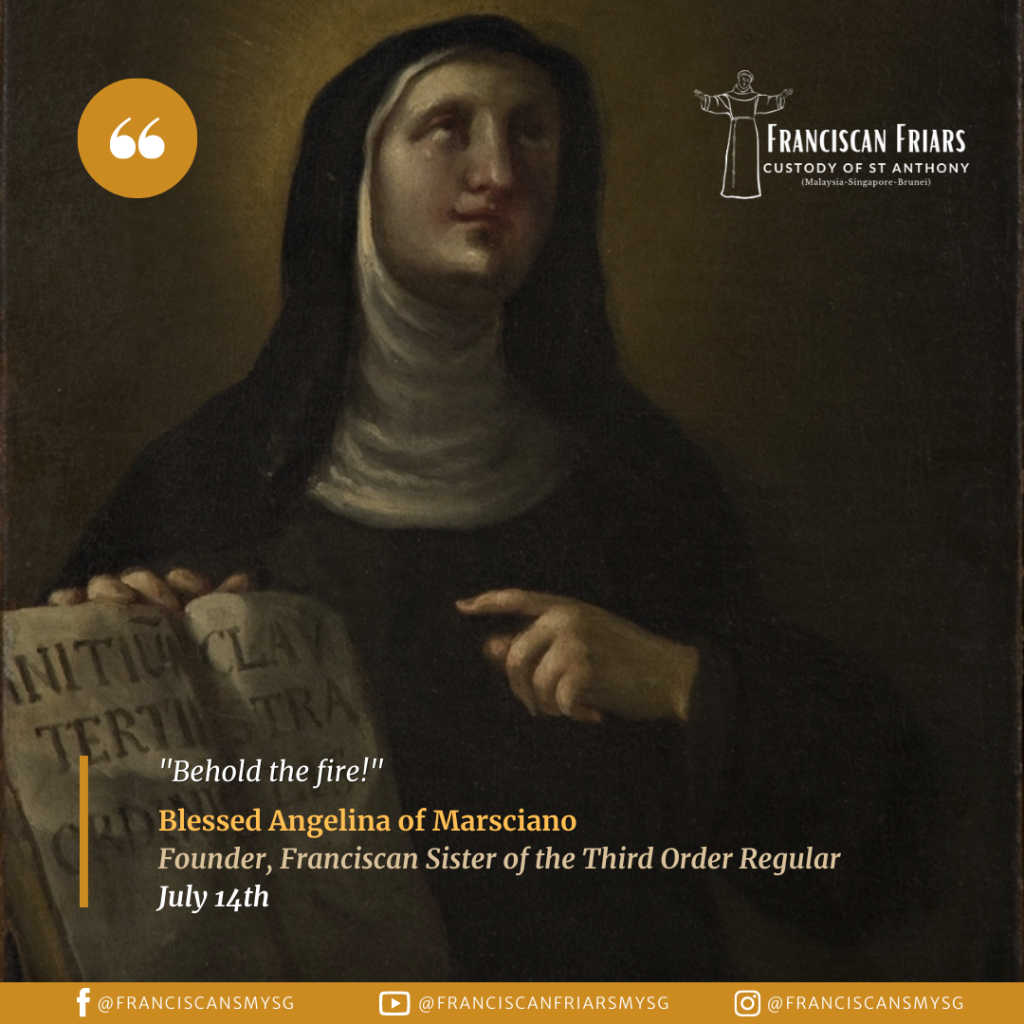
Angelina, who was raised in a noble family, married the count of Civitella when she was fifteen. Two years later, her husband died, and Angelina inherited his title and castle. Straightaway, she put on the habit of a Franciscan tertiary and gathered her female attendants into a religious community. Together they began to travel throughout the region, calling sinners to conversion and extolling the virtues of virginity. So effective were her paeans to virginity that she was deemed a threat to civil order. Placed under arrest, she was denounced as a witch (because of her sway over young girls) and a heretic (because of her supposed rejection of marriage). Yet, when she was brought before King Ladislas of Naples, who was fully prepared to have her burned, she mounted an effective defense. “If I have taught or practiced error,” she said, “I am prepared to suffer the appropriate punishment.” With that she drew back her cloak to reveal burning embers, hidden within. The king was sufficiently impressed that he spared her the worst punishment. Still, he exiled her from the kingdom.
On pilgrimage to Assisi, Angelina received a vision that she should found an enclosed monastery of the Third Order Regular of St. Francis in Foligno. In 1397, with support from the local bishop, she accomplished this plan. Other communities gradually affiliated with her convent, and they were recognized as a new congregation in 1428. Angelina died on July 14, 1435. She was beatified in 1825.
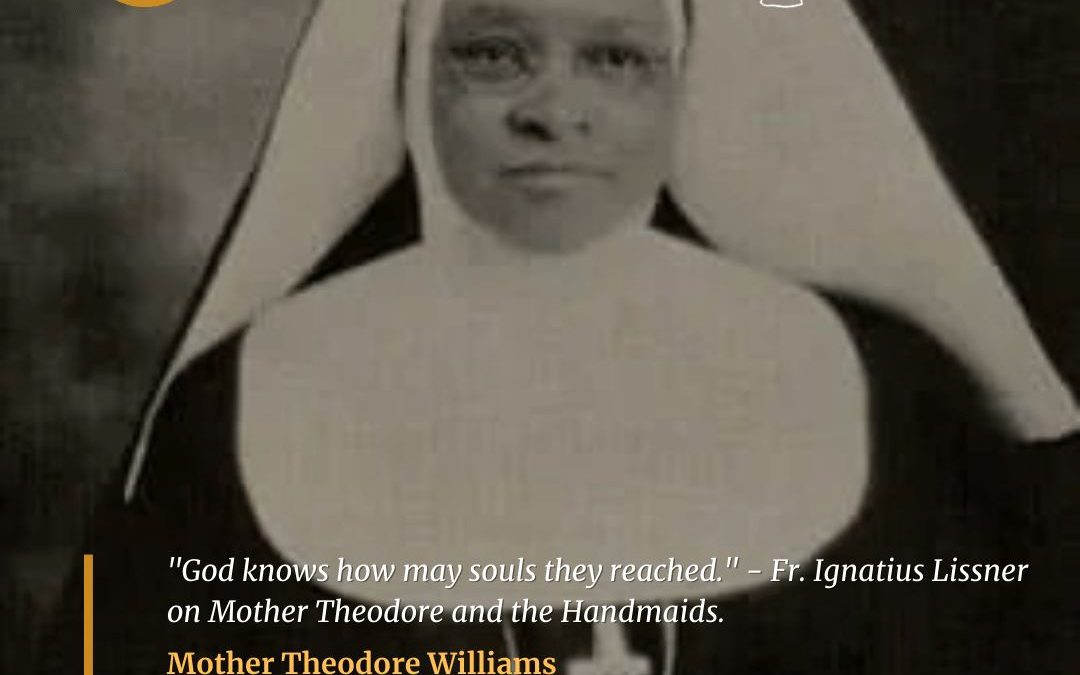
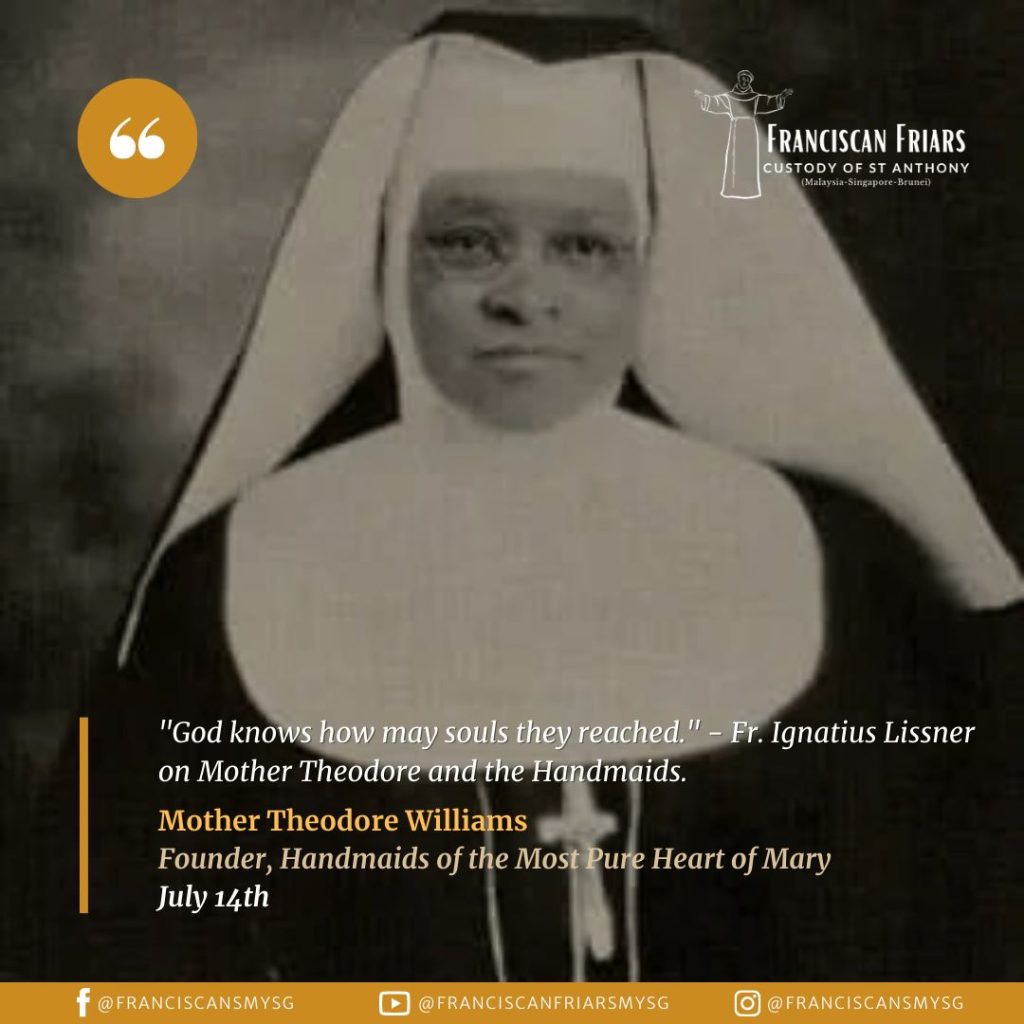
Elizabeth Barbara Williams was born to a large Catholic family in Baton Rouge. Though she felt called to religious life, there were at the time few options available for an African American woman in the South. For some years she worked as a receptionist for a convent of white nuns. Then, in 1916, she was approached by a French priest, Fr. Ignatius Lissner, who was serving the black Catholic community in Savannah. At the time, laws were under consideration that would prevent white teachers, like the sisters in Lissner’s parish school, from teaching black children. In response, Fr. Lissner wished to start a congregation of black sisters. In Williams, he found an enthusiastic partner. As Mother Theodore, Williams became the founder of the Handmaid of the Most Pure Heart of Mary.
When she proposed laws were not passed, the Handmaid found themselves struggling to find their mission. Though they were largely accepted in the community, they confronted doubts from certain white nuns. As Fr. Lissner noted, “As real Southerners they could not believe a colored woman could make a real Religious Sister…’It is a shame,’ they said. ‘Fr. Lissner may give them the veil, but what will that prevent them from stealing chickens and telling lies?”
Then, in 1923, Archbishop Patrick Hayes invited the Handmaids and relocate to Harlem. There, besides teaching, they operated soup kitchen, a kindergarten, and a shelter for homeless children. In 1929, Williams affiliated her community with the Franciscans. She died in July 14, 1931.
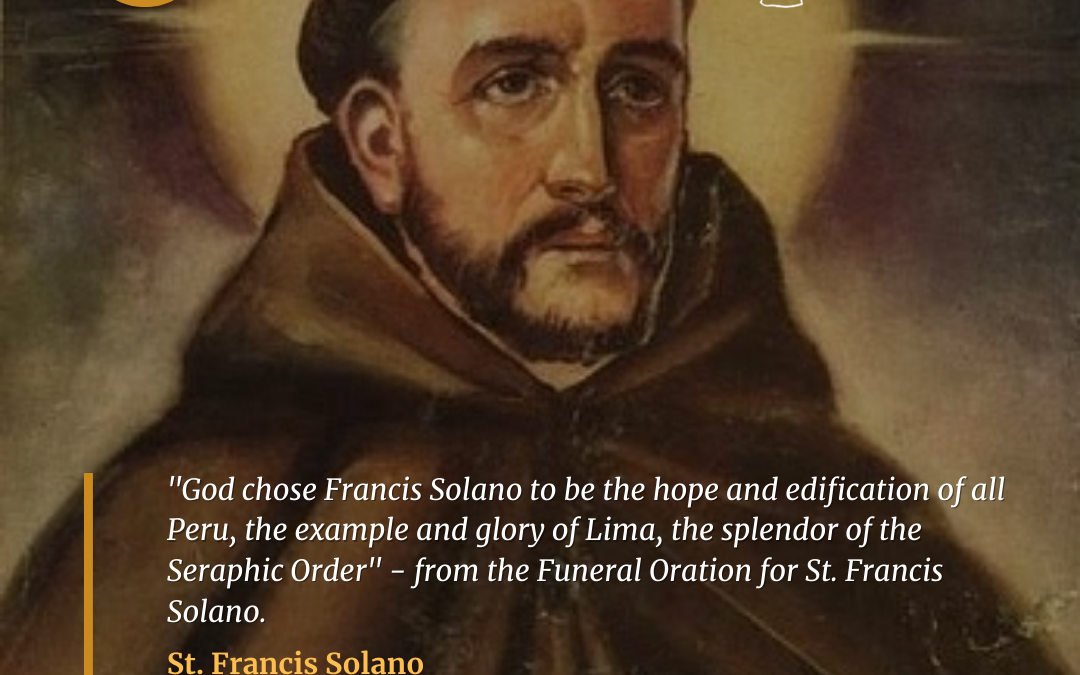
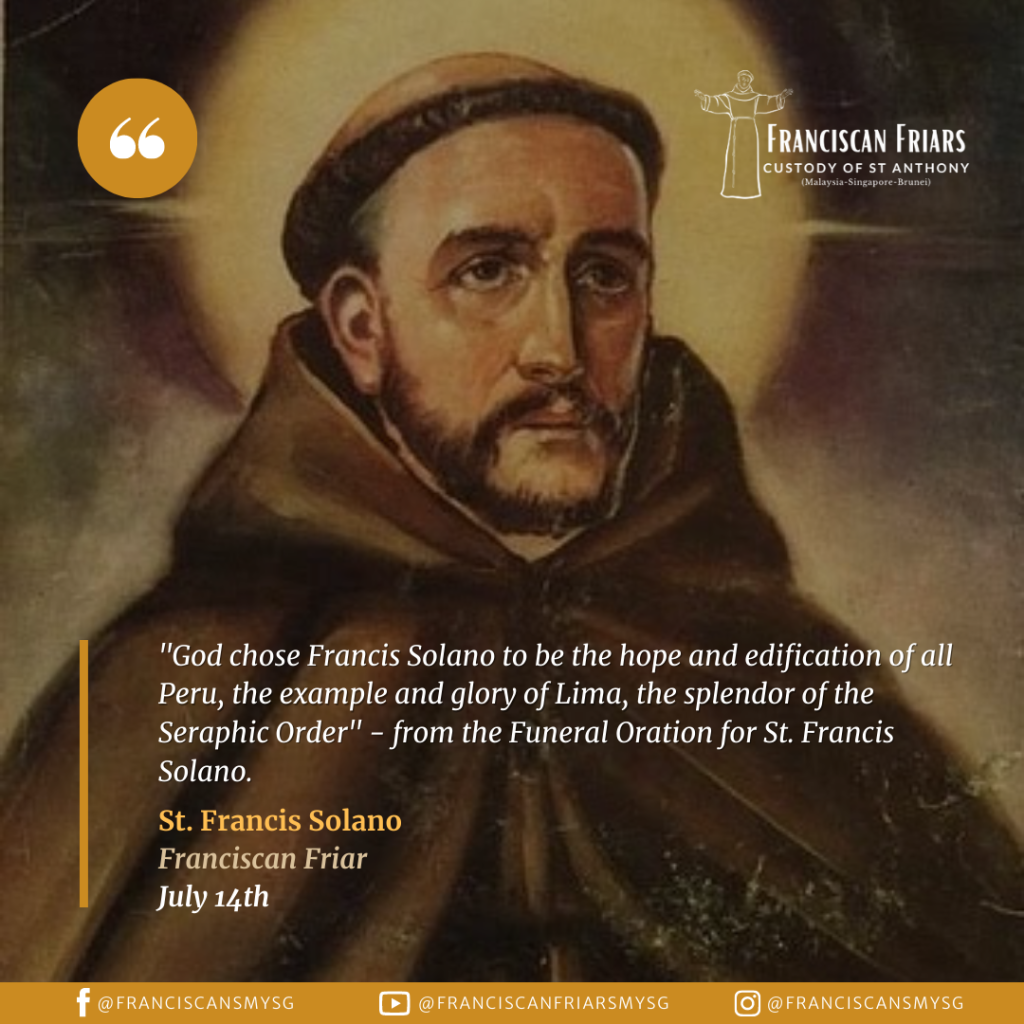
Francis Solano was born in the Andalusian town of Montilla, where he joined the Franciscans in 1569. While ministering in southern Spain, he cared for the victims of plague, a most perilous undertaking. At one point, he himself nearly died of the disease. Though he wished to be assigned to Africa, in 1589 Francis was sent to Peru. Along the way, a fierce storm drove his ship onto a sandbar close to shore. While the rest of the crew abandoned shop, leaving behind a cargo of African slaves, Francis chose to remain behind. Three days later, when the weather cleared, the survivors were rescued.
For his achievements over the next twenty years, Francis became known as the “Wonderworker of the New World.” Venturing into the remote region of Tucaman, in present day Argentina and Paraguay, he went out to meet the Indians, announcing his arrival with the sound of his violin. He was gifted in learning the indigenous languages – so much so that he was reputed to have a “gift of tongues.” But though his gentleness won the Indians’ affection, his efforts to protect them from Spanish exploitation had only mixed results.
Later he was assigned to Lima. There, his preaching against corruption and injustice caused such an uproar that his superiors pleaded with him to moderate his speech. He died on July 14, 1610, having uttered his last words: “Glory be to God.” He was canonized in 1726.
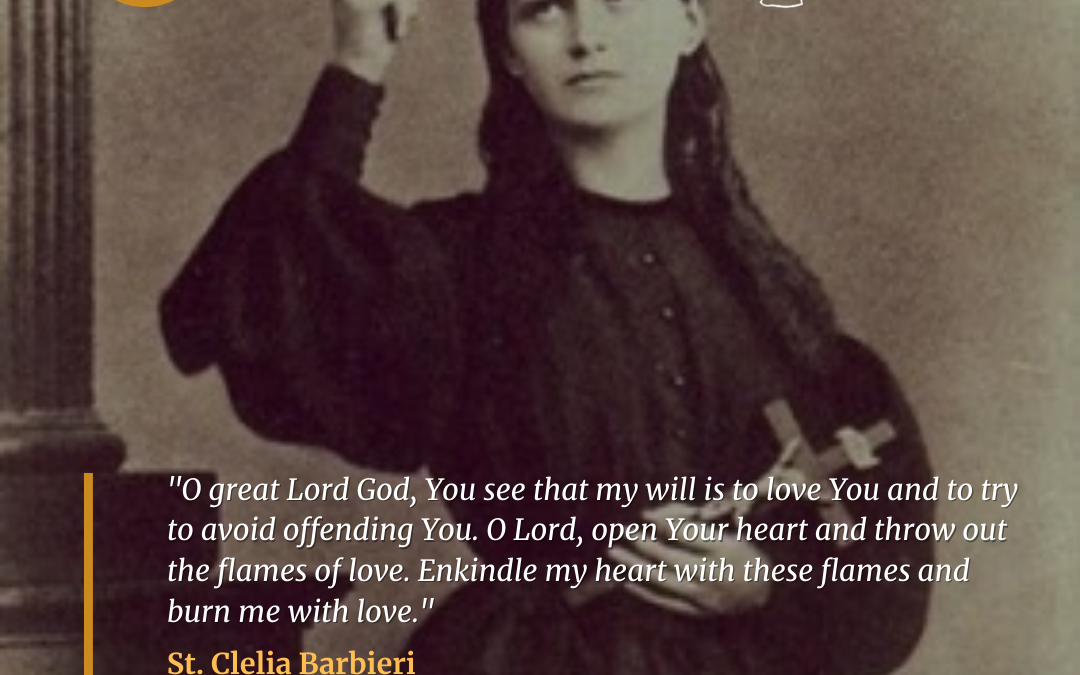
Clelia Barbieri was born in 1847 to a poor family on the outskirts of Bologna. After her father’s death, when she was eight, she went to work spinning hemp. Despite her own modest circumstances, Clelia sought every opportunity to serve her neighbors. She became well known in her parish for teaching catechism and encouraging other young girls in their faith. During this time, she conceived the idea of gathering a household of other young women who would devote themselves to prayer and good works. With support from their parish priest, they took over an abandoned house and implemented this vision. Neighbors arrived the first night with donations of food. Clelia remarked, “I like the idea that our house resembles the crib where the shepherds bring their gifts.”
Clelia and her companions endured poverty and hardship. In time, the Minims of Our lady of Sorrows, under the patronage of St. Francis of Paola. Clelia devised a rule that emphasized community, the spirit of contemplation, the practice of charity, simplicity, and joy. But her years were limited. She succumbed to tuberculosis at twenty-three, dying on July 13, 1870. She was canonized in 1989.