
Saint Paschal Baylon (1540–1592)
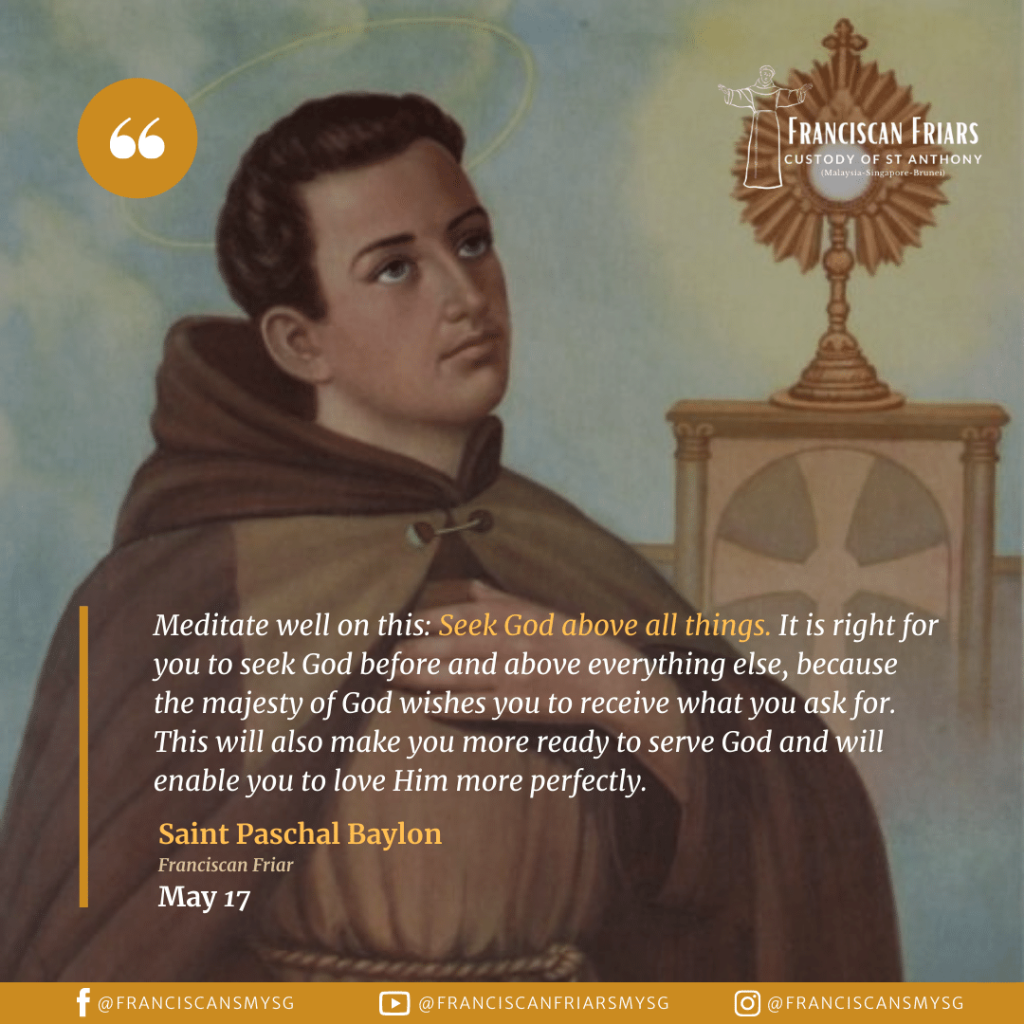
St. Paschal, who was born in Spain, spent his early life as a shepherd. Though he had no formal education, he taught himself to read and write, and he enjoyed the long days and nights with his flock, which afforded hours of uninterrupted prayer. At the age of twenty-one, he applied for admission to a friary of reformed Franciscans of St. Peter of Alcántara, a community known for its strict poverty and austerity. Paschal adapted happily to this environment, assigned mostly to menial tasks and joining his brothers in care for the poor and sick.
What distinguished Paschal was his extraordinary devotion to the Eucharist. He would spend hours each night or early morning on his knees before the Blessed Sacrament. Often he volunteered to serve at one Mass after another. Even while he lived he was known as “the saint of the Eucharist.” And later, long after his death, he would be named the patron of all Eucharistic congresses and confraternities of the Blessed Sacrament.
On one occasion, Paschal was sent on a mission to France carrying letters for the minister general of the Observant Franciscans. It was a dangerous undertaking to cross Huguenot territory in his Franciscan garb, and several times he was stoned and severely injured. Nevertheless, he returned safely to resume his simple life.
He died on May 17, 1592, at the age of fifty-two. He was canonized in 1690.
I was born poor and am resolved to die in poverty and penance.
– St Paschal Baylon
Source : The Franciscan Saints (Franciscan Media)
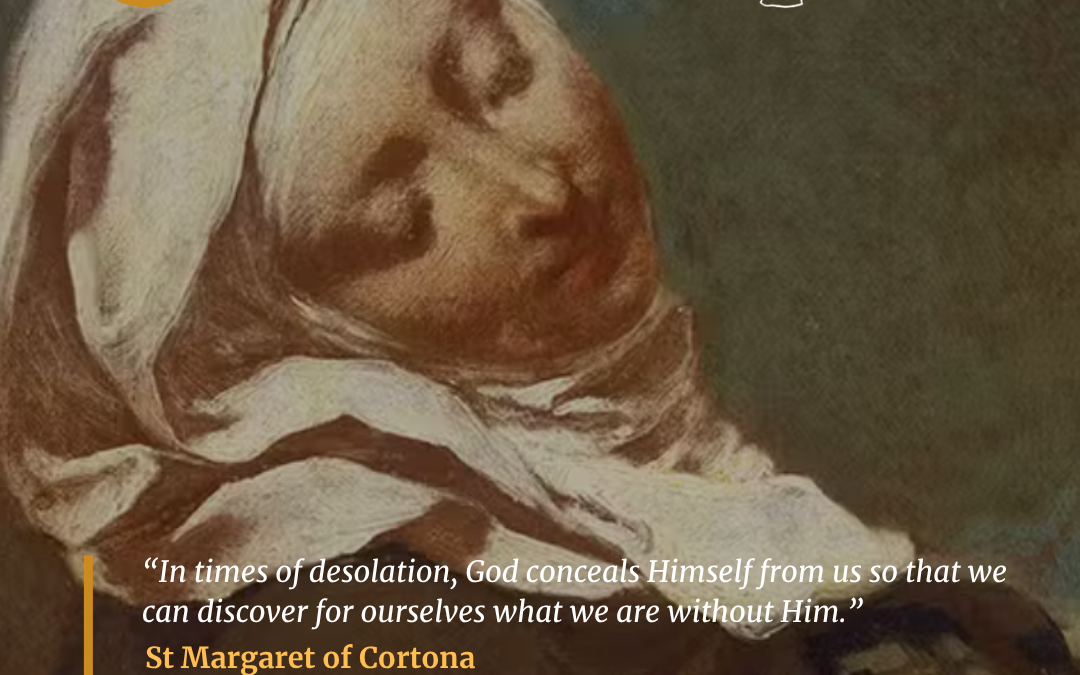
Saint Margaret of Cortona (1247-1297)
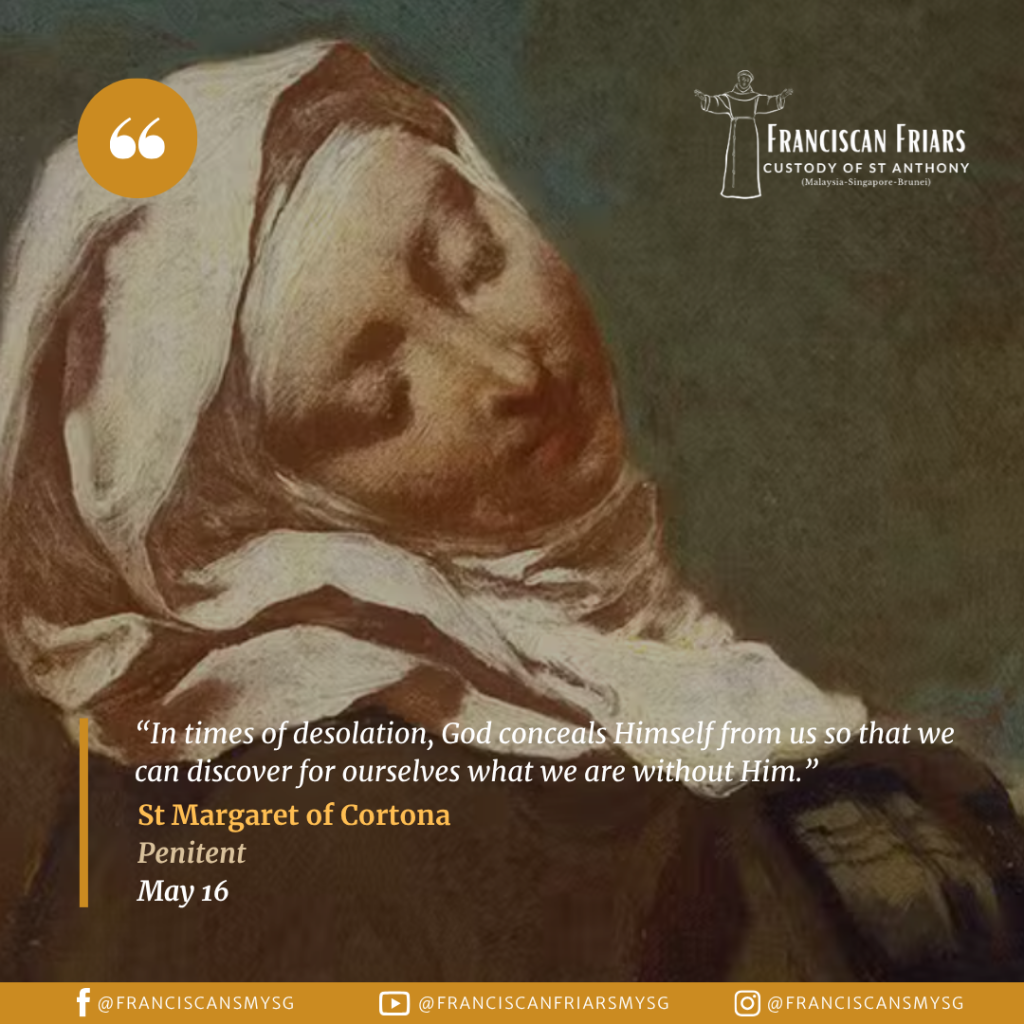
Margaret was born of farming parents in Laviano, Tuscany. Her mother died when Margaret was seven; life with her stepmother was so difficult that Margaret moved out. For nine years she lived with Arsenio, though they were not married, and she bore him a son. In those years, she had doubts about her situation. Somewhat like Saint Augustine, she prayed for purity—but not just yet.
One day she was waiting for Arsenio and was instead met by his dog. The animal led Margaret into the forest where she found Arsenio murdered. This crime shocked Margaret into a life of penance. She and her son returned to Laviano, where she was not well received by her stepmother. They then went to Cortona, where her son eventually became a friar.
In 1277, three years after her conversion, Margaret became a Franciscan tertiary. Under the direction of her confessor, who sometimes had to order her to moderate her self-denial, she pursued a life of prayer and penance at Cortona. There she established a hospital and founded a congregation of tertiary sisters. The poor and humble Margaret was, like Francis, devoted to the Eucharist and to the passion of Jesus. These devotions fueled her great charity and drew sinners to her for advice and inspiration. She was canonized in 1728. St. Margaret of Cortona’s liturgical feast is celebrated on February 22.
“In times of desolation, God conceals Himself from us so that we can discover for ourselves what we are without Him.”
Source: Franciscan Media
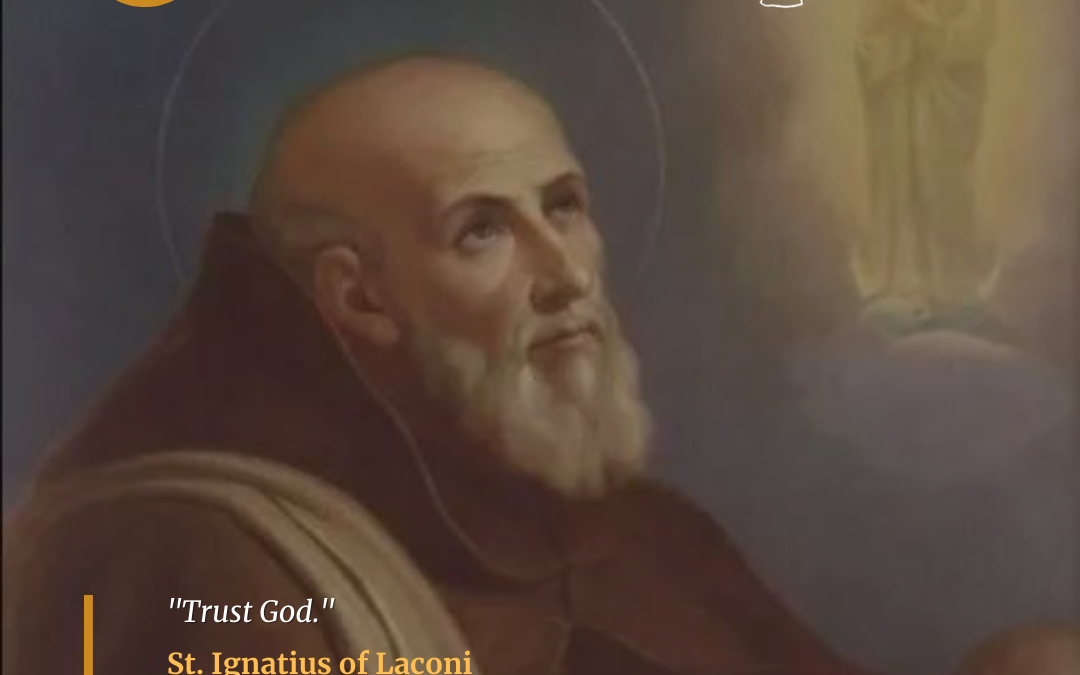
Saint Ignatius of Laconi (1700-1781)
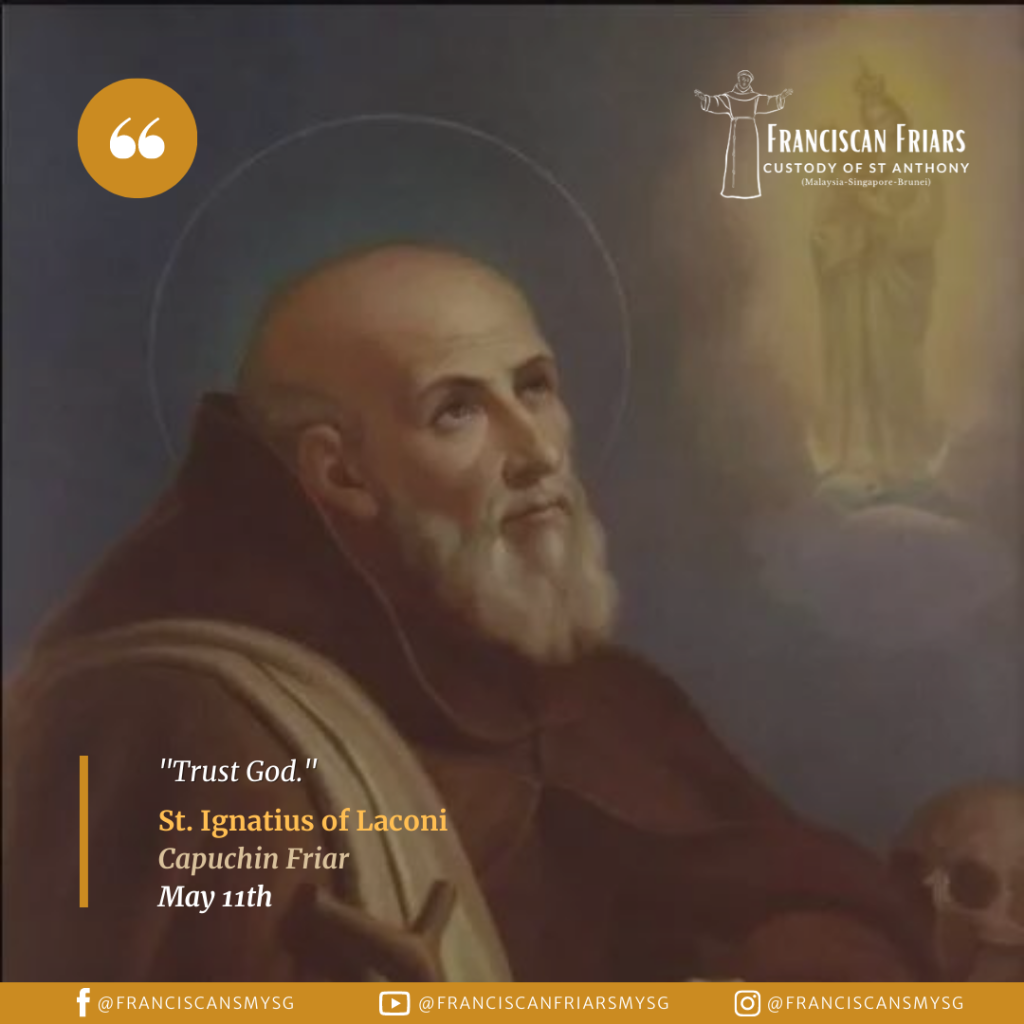
Francis Ignatius Vincent was born to a large family in the village of Laconi in Sardinia. He was a frail child and during one bout of illness his mother vowed, should he recover, that she would give him to the Franciscans. When he did rally, his father balked at fulfilling this pledge. “Today or tomorrow,” he reasoned, “this year or the next, it all comes to the same thing.” But Francis would not be deterred from his vocation. When he was twenty-one, he applied to the Capuchins and received the name Brother Ignatius.
Ignatius spent most of his life in obscure and humble assignments. He had no special talents, save his extraordinary aptitude for begging. This became the principal occupation of his life. People proved exceptionally happy to give him alms, and in exchange he often reconciled feuding neighbors, reformed sinners, or left a trail of miraculous healings.
There was in town a notorious moneylender whom Ignatius never approached. The moneylender took offense at this ostracism and complained to the Capuchin superior, who subsequently instructed Ignatius to include this man on his rounds. Ignatius complied with this command, and he returned that evening with a bag filled with food. But when he opened it up it was dripping with blood. “What is this?” asked the superior. “Father Guardian,” Ignatius replied, “this is the blood of the poor. And that is why I ask nothing from that house.”
Ignatius died on May 11, 1781. He was canonized on 1951.
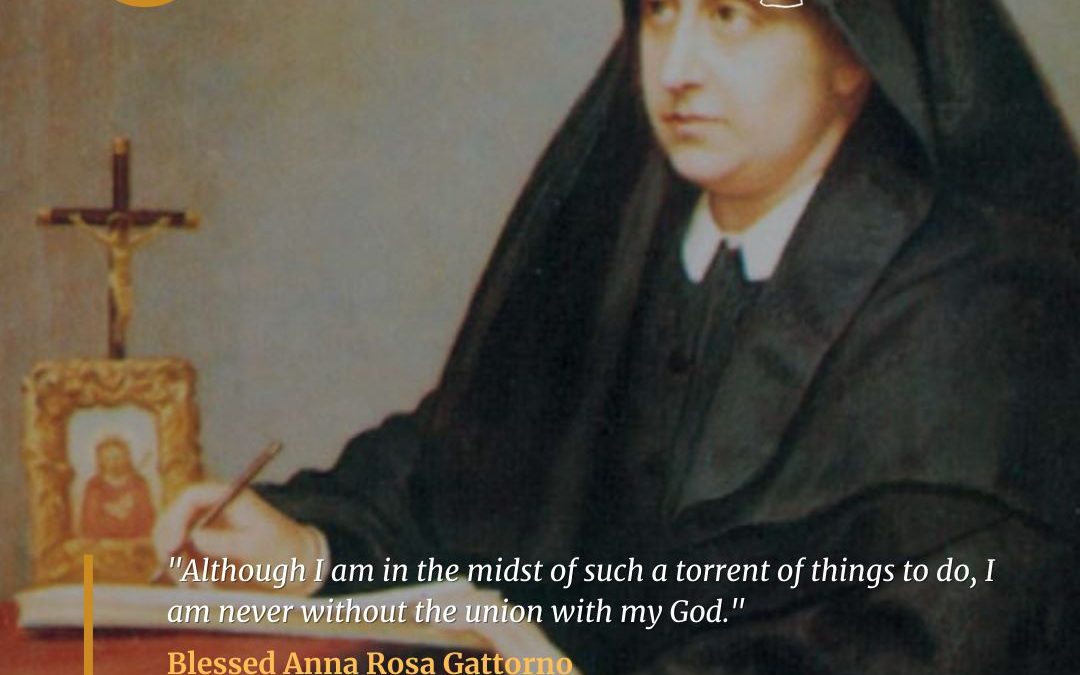
Blessed Anna Rosa Gattorno (1831-1900)
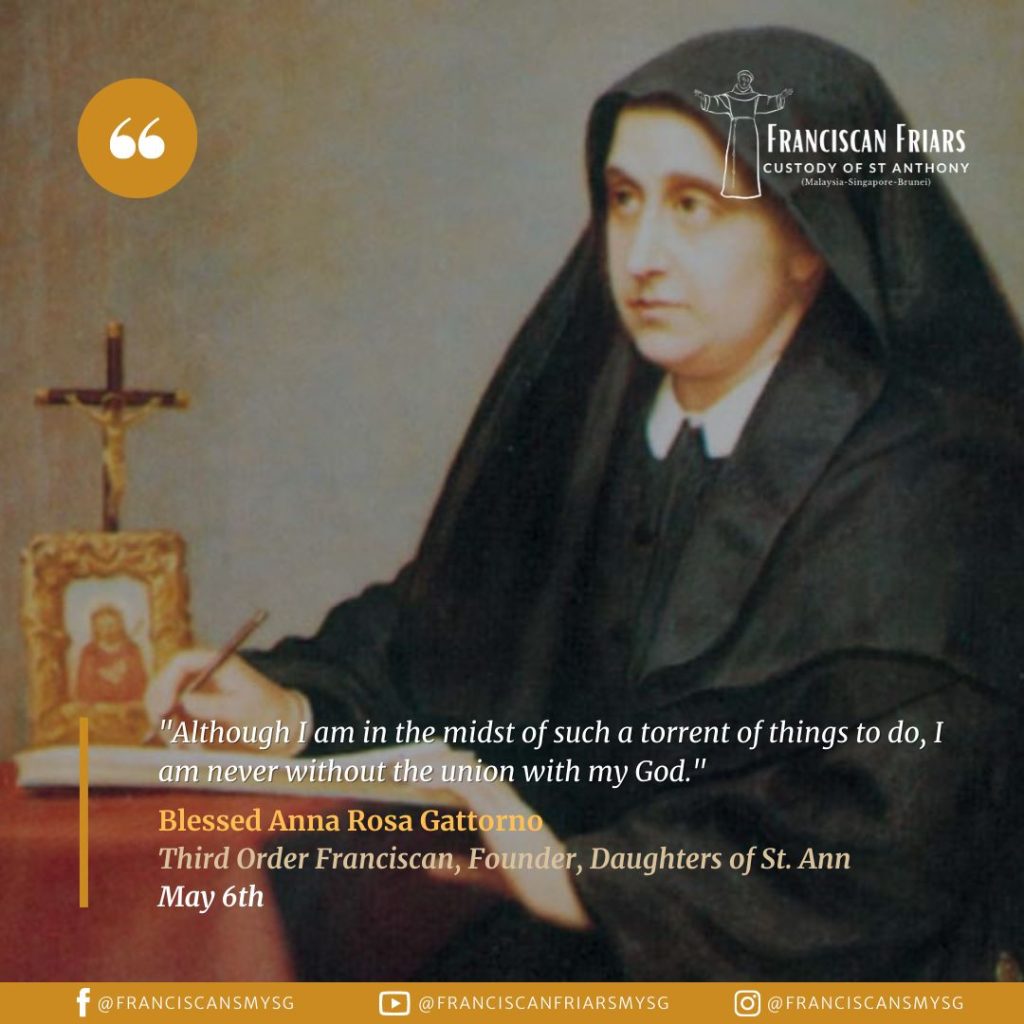
Benedetta Gattorno was born in Genoa to a wealthy family. Married at twenty-one, she was widowed six years later, with two young children to care for – one of them deaf and mute. Despite these challenges, she underwent what she called a “conversion” to greater love of God and her neighbors. Already a daily communicant, she took private vows of chastity and obedience, later adding poverty when she became a Franciscan tertiary.
Her confessor urged her to established a religious congregation, but she worried about what would happen to her children. In this, she received encouragement from Pope Pius IX. During an audience, he reassured her that God would provide for her children. And so, in 1866, she founded the Daughters of St. Anne (named for the mother of Mary), and later took the name Anna Rosa. The mission of the sisters was to be “Servants of the poor and ministers of mercy,” seeking out and responding to all forms of suffering – whether among the poor, the abandoned, orphans, the sick, or elderly. She took a special interest in deaf children.
In 1878, the first sisters left Italy to establish houses in Latin America and other parts of Europe. By the time of Anna Rosa’s death on May 6, 1900, there were thirty-five hundred sisters at work in over three hundred houses. She was beatified in 2000.