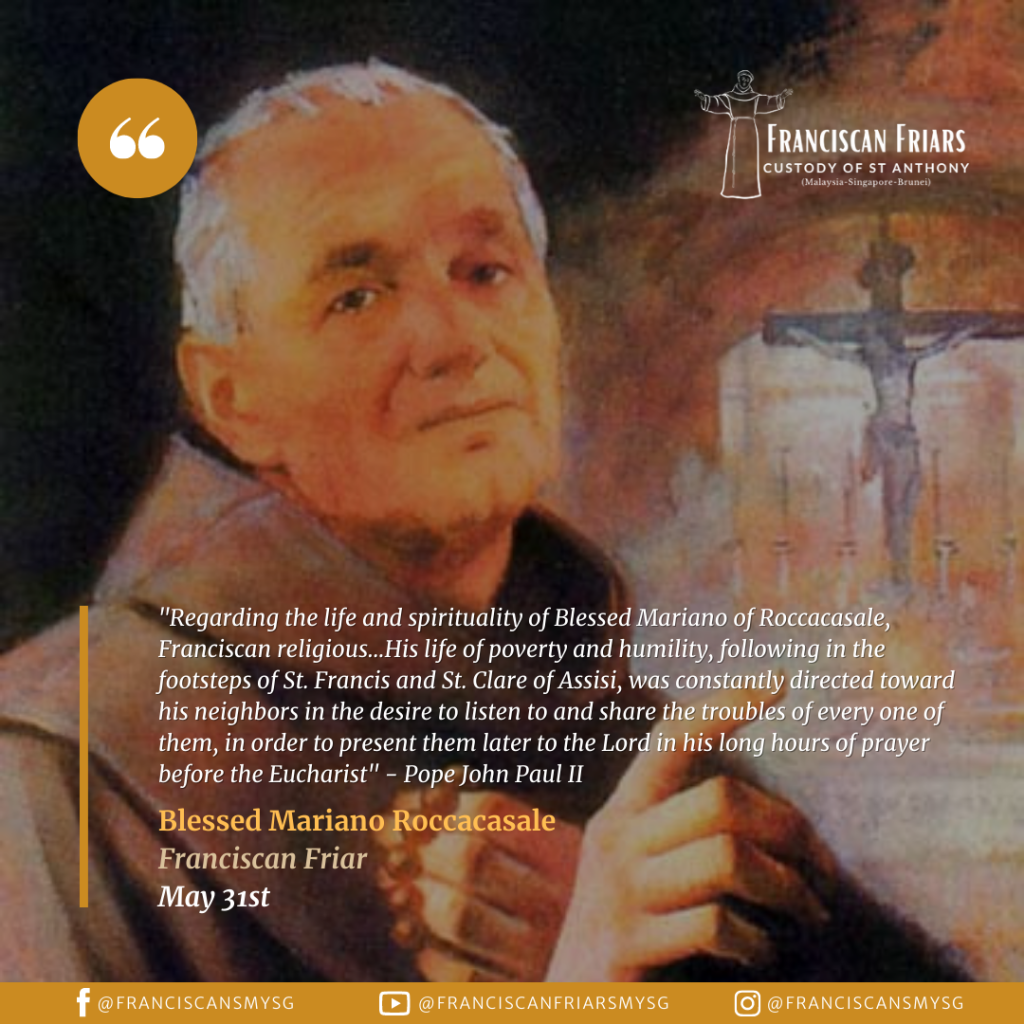
Mariano was born to a peasant family in Roccacasale in Italy. One day, tired and thirsty while caring for his sheep on a rugged hillside, he fell asleep and had a dream in which a Franciscan friar showed him where to find water. When he awoke, he removed a stone beneath his head, untapping a vigorous stream, which runs to this day.
When he was twenty-three, he joined a Franciscan community in Arisquia, where he remained for twelve years, dividing his time between prayer and simple labor. But he felt something was lacking. Eventually he received permission from his community to visit Bellagra, where many holy friars had established hermitages. He ended up remaining there for the next forty-years, serving as doorkeeper – an office that afforded opportunities to greet pilgrims, travellers, and the poor who made their way to his door. Welcoming each guest with the Franciscan greeting, “Peace and Good,” he would offer food, a place to rest, and his own spiritual counsel. This was his path to holiness.
He died on May 31, 1866. He was beatified in 1999.
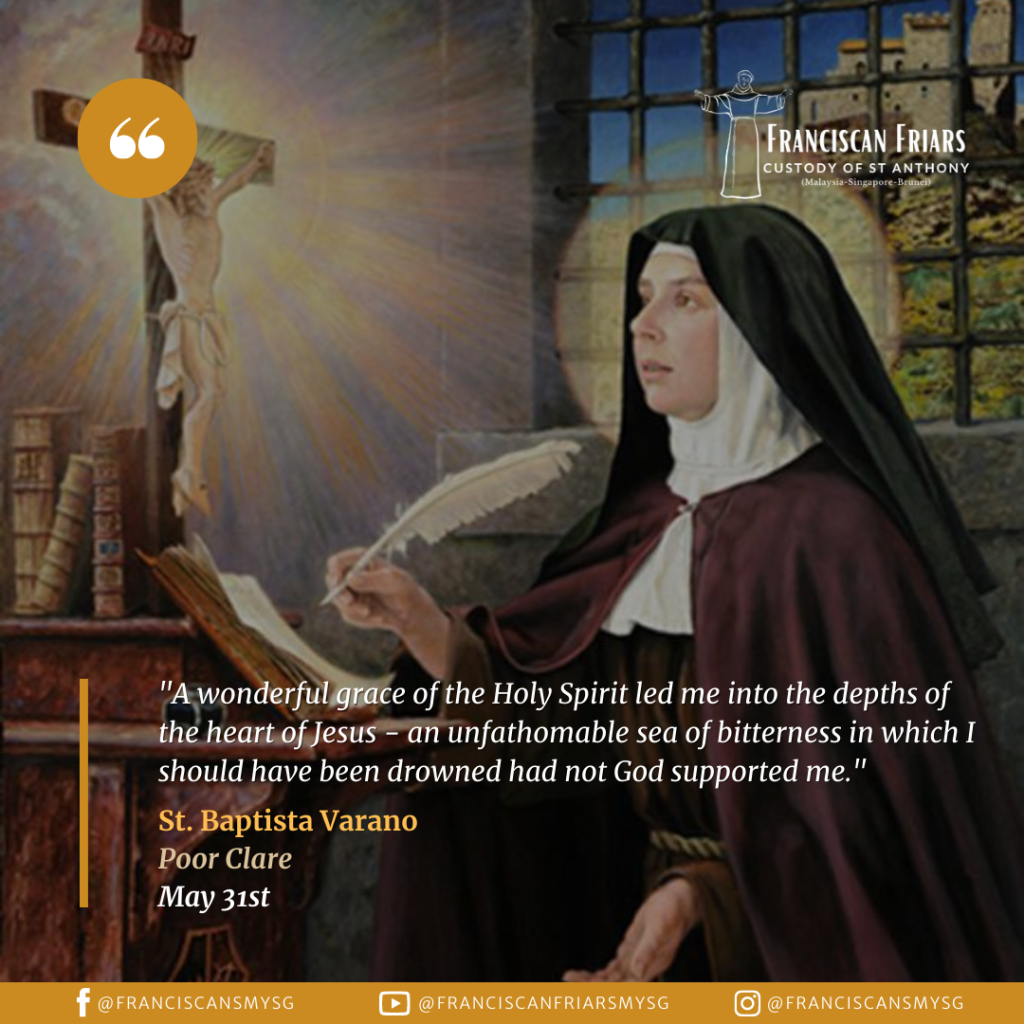
Camilla Varano was the daughter of a powerful Italian prince and his mistress. Raised by the father and his lawful wife, she was groomed for a life in this highest circles of society. For many years she embraced this world of “music, dancing, dress, and other worldly amusements.” She could “not bear” the sight of monks or nuns. Then one day she heard a sermon that hit her like a thunderbolt. In response to prayer she received the gift of “three lilies”: hatred of the world, a sense of unworthiness, and a willingness to suffer. Gradually she found herself attracted to religious life.
Her father did everything he could to thwart her vocation – even to the point of locking her up. But after two years, when she was twenty-three, he relented and allowed her to enter the Poor Clares, where she took the name Baptista. She likened the experience to crossing the Red Sea to escape from slavery under Pharoah.
In the newfound freedom of the cloister, Baptista began to experience vivid mystical visions, including colloquies with St. Clare. In another case, two winged angels held her aloft to contemplate the bleeding feet of Christ on the cross. She composed several books describing the inner suffering of Christ, as well as offering spiritual instructions.
Baptista died on May 31, 1524, and was canonized in 2010.
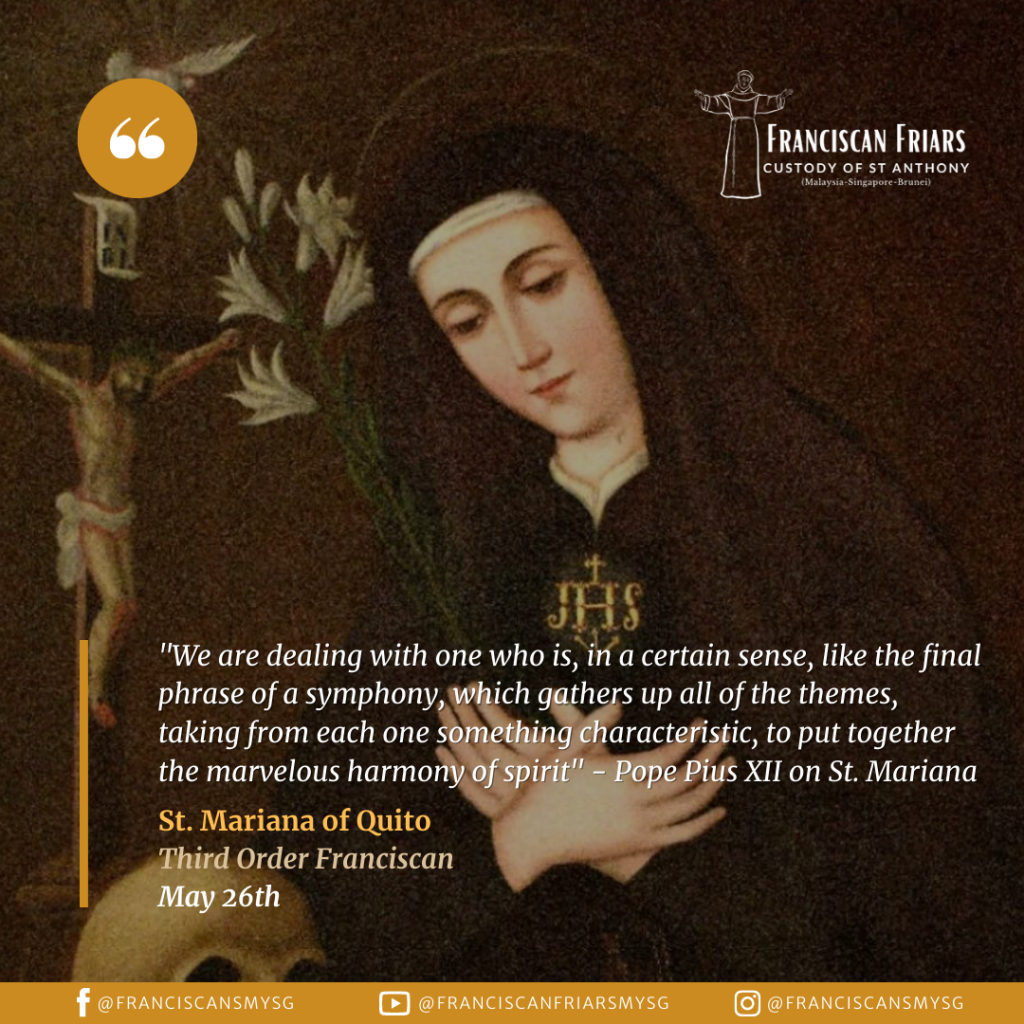
Mariana de Paredes, the patron saint of Ecuador, was born in Quito to aristocratic parents. As a child, she dreamed of joining a convent, or even carrying the Gospel to Japan. But after her parents died, she moved in with her sister and brother-in-law, and there, under the direction of a Jesuit confessor, spent the rest of her life. Upon receiving the habit of a Franciscan tertiary, she took the name of Mariana of Jesus.
It is painful to read of the austerities she imposed on herself: extreme fasting, long vigils, and a crown of thorns. As a reminder of death, she spent each Friday night sleeping in a coffin. In exchange of these sacrifices, she received many spiritual favors, including the gift of prophecy and the power to effect miraculous healings.
In 1645, Quito was struck by a series of earthquakes, followed by a terrible epidemic that claimed over fourteen hundred lives. When a preacher proclaimed that these sufferings were a result of people’s sins, Mariana publicly offered herself as a victim. Immediately the earthquakes ceased. But Mariana fell mortally ill and died on May 26, 1645, at the age of twenty-six. Hailed as a savior of her city, she was mourned by all of Quito. She was canonized in 1950.
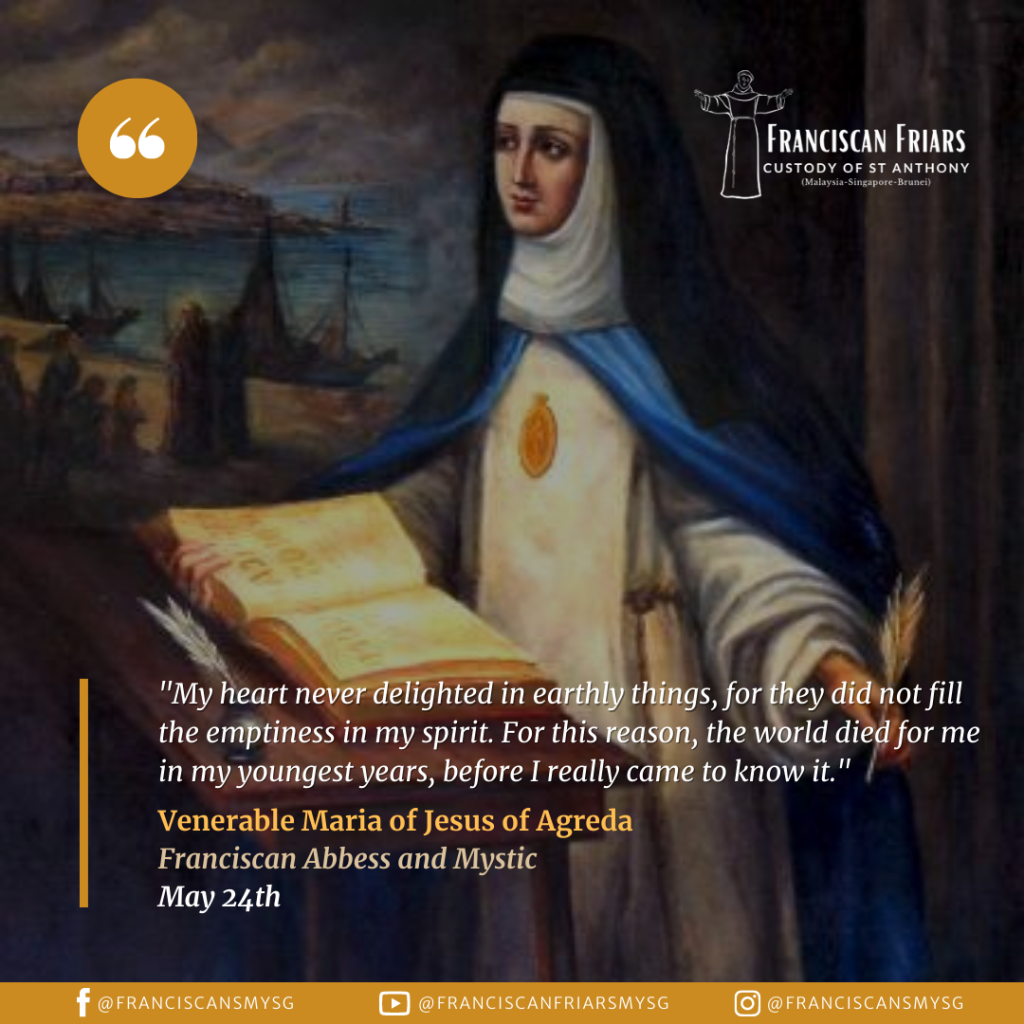
Maria of Jesus spent her entire life within the confines of her family castle in Agreda, Spain, which her mother – when Maria was only twelve – had converted into a convent for herself and her daughters. In this Franciscan Convent of the Immaculate Conception of Agreda, Maria eventually served as abbess, renowned for her mystical writings and her ardor in prayer.
And yet, in the spiritual realm, she was anything but a stay-at-home nun. In her early twenties, she found herself repeatedly transported in prayer to the Indian settlements in New Spain, particularly to a tribe of hunter-gatherers called the Jumanos in present-day New Mexico. In the course of what she reckoned were five hundred trips, she was able to communicate with the Indians in their own language, instructing them in the faith, and urging them to seek baptism. This remarkable story gained credence when friars in New Spain encountered just such a tribe who requested baptism and claimed they had met frequently with a Lady in Blue (just like Maria).
These reports were taken seriously enough to justify a trip to Agreda by the Franciscan superior for New Mexico. Maria was also subjected to two inquiries by the Inquisition, resulting in no action. (Her defenders included King Philip IV of Spain.)
She died on May 24, 1665. Ten years later, she was declared venerable by Pope Clement X.
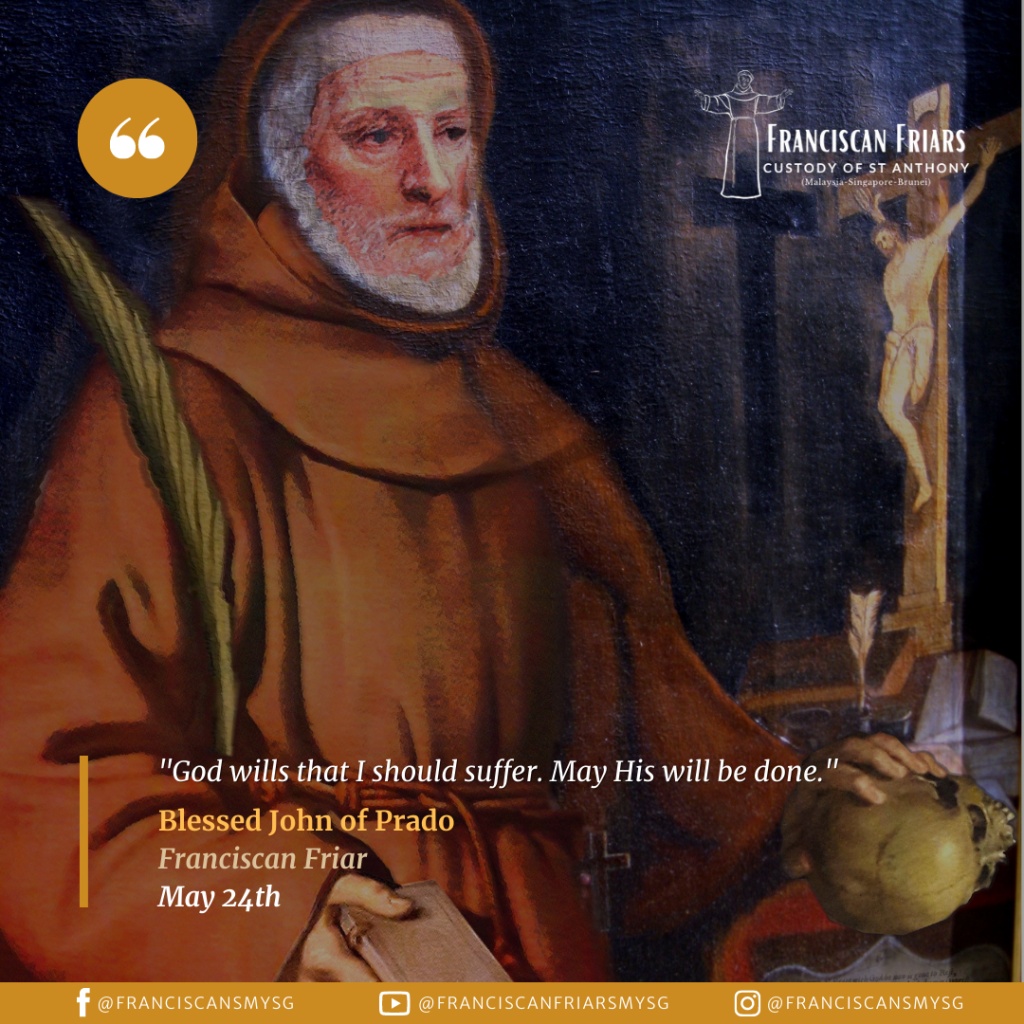
John of Prado was born in to a noble family in Spain. After studies at Salamanca University he became an Observant Franciscan. Though he wished to pursue mission work in North Africa, his superiors instead gave him preaching assignments at home. He filled various offices in his order, though at one time he was removed from office on account of some unfounded accusation. After his eventual vindication, he was given a new assignment as minister of the province of San Diego.
A number of Franciscans at the time were working in Morocco, particularly among Christian slaves. When they all died during an outbreak of plague, John asked permission to take their place. After being named apostolic missionary by Pope Urban VIII, he set off with two companions, In Morocco, he managed to gain access to the Christian slaves and ministered to them, bolstering their faith and providing the sacraments. When his activities were discovered, he was imprisoned in chains and forced to turn a grindstone. Brought before the sultan, he proclaimed his faith and refused to apostatize. After being scourged, he was again returned for examination. This time, John began to preach to the audience, which included a number of Christian apostolate. This enraged the sultan, who struck him to the ground and ordered his execution. He was burned alive in the public square, all the while singing Christ’s praises.
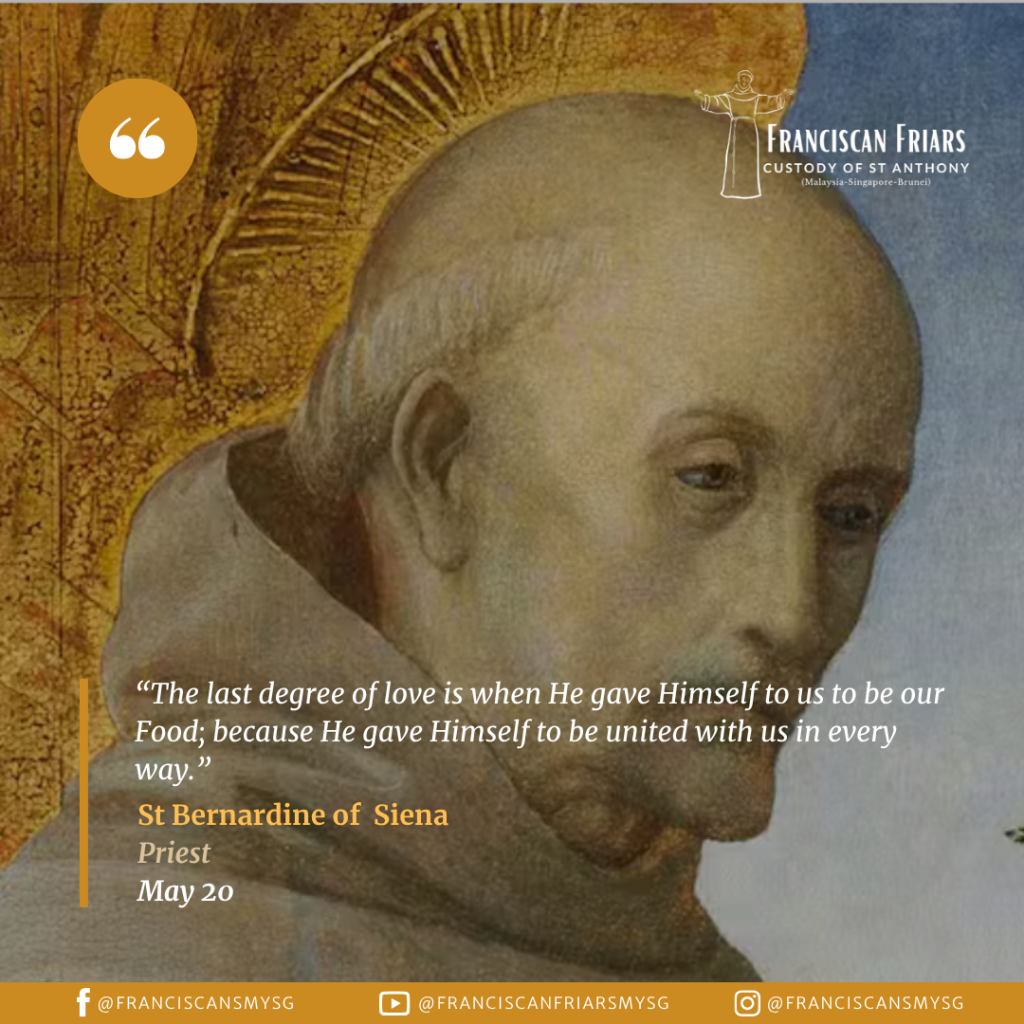
Most of the saints suffer great personal opposition, even persecution. Saint Bernardine of Siena, by contrast, seems more like a human dynamo who simply took on the needs of the world.
He was the greatest preacher of his time, journeying across Italy, calming strife-torn cities, attacking the paganism he found rampant, attracting crowds of 30,000, following Saint Francis of Assisi’s admonition to preach about “vice and virtue, punishment and glory.”
Compared with Saint Paul by the pope, Saint Bernardine of Siena had a keen intuition of the needs of the time, along with solid holiness and boundless energy and joy. He accomplished all this despite having a very weak and hoarse voice, miraculously improved later because of his devotion to Mary.
When he was 20, the plague was at its height in his hometown of Siena. Sometimes as many as 20 people died in one day at the hospital. Bernardine offered to run the hospital and, with the help of other young men, nursed patients there for four months. He escaped the plague, but was so exhausted that a fever confined him for several months. He spent another year caring for a beloved aunt whose parents had died when he was a child, and at her death began to fast and pray to know God’s will for him.
At 22, he entered the Franciscan Order and was ordained two years later. For almost a dozen years he lived in solitude and prayer, but his gifts ultimately caused him to be sent to preach. He always traveled on foot, sometimes speaking for hours in one place, then doing the same in another town.
Especially known for his devotion to the Holy Name of Jesus, Saint Bernardine of Siena devised a symbol—IHS, the first three letters of the name of Jesus in Greek—in Gothic letters on a blazing sun. This was to displace the superstitious symbols of the day, as well as the insignia of factions: for example, Guelphs and Ghibellines. The devotion spread, and the symbol began to appear in churches, homes and public buildings.
Opposition arose from those who thought it a dangerous innovation. Three attempts were made to have the pope take action against him, but Bernardine’s holiness, orthodoxy, and intelligence were evidence of his faithfulness.
General of the Friars of the Strict Observance, a branch of the Franciscan Order, Saint Bernardine of Siena strongly emphasized scholarship and further study of theology and canon law. When he started there were 300 friars in the community; when he died there were 4,000. He returned to preaching the last two years of his life, dying while traveling.