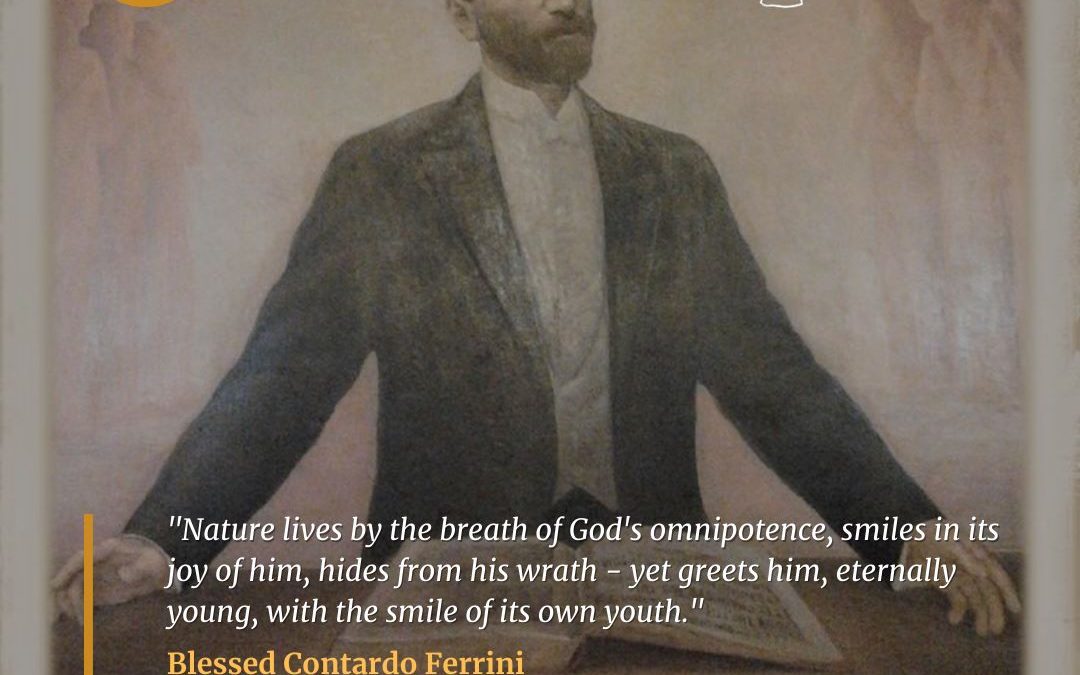
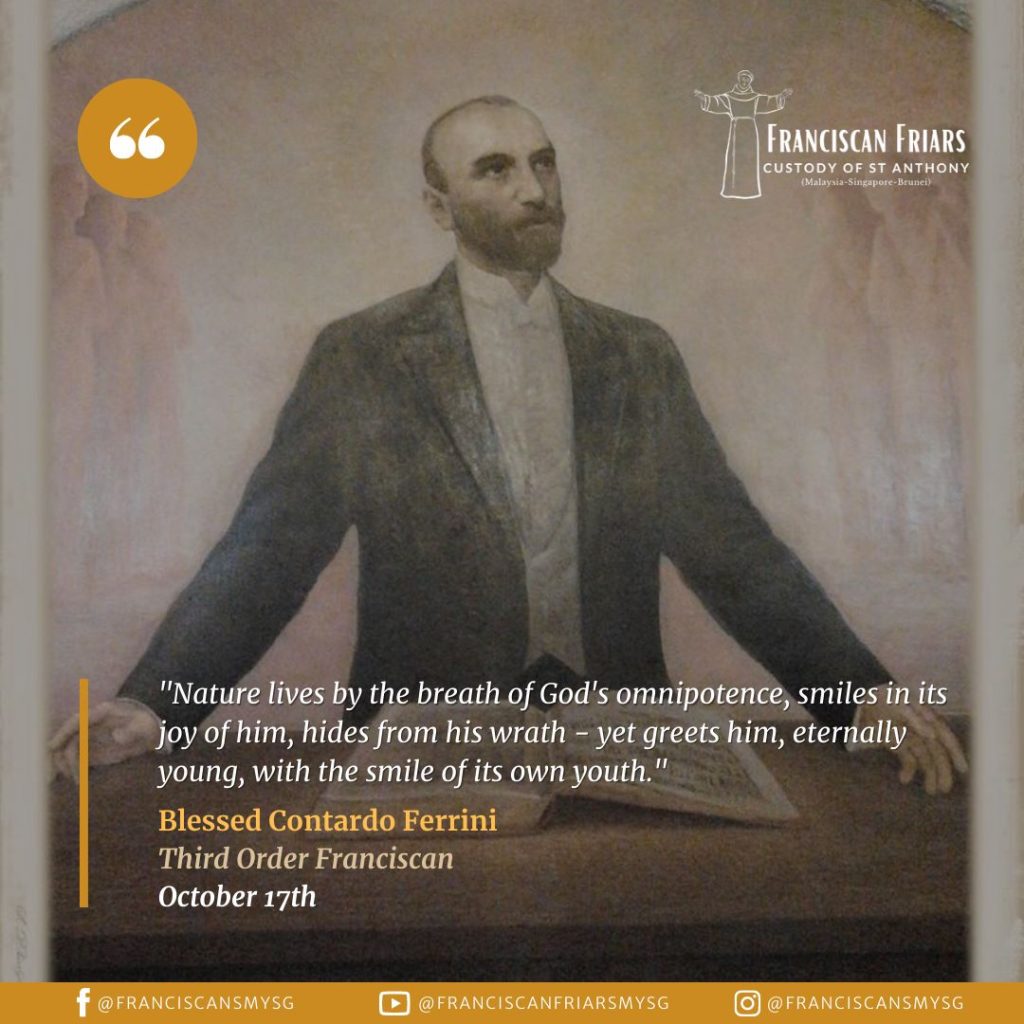
Among the great majority of official saints drawn from traditional “religious life,” Contardo Ferrini stands out as a layman who lived out his faith in the world of scholarship and civic service. From his early youth he displayed a deep dedication to prayer. But rather than enter the priesthood, he chose the academic life as his own path to holiness. Through studies in Pavia in Italy, and later in Berlin, he became one of the world’s authorities on Roman law. He taught at a number of universities and published hundreds of scholarly articles and several textbooks. In 1895, he was elected to the municipal council of Milan. Apart from this work he had a passion for nature and mountaineering.
Although he was a Franciscan tertiary, he was not the type of saint famous for exceptional acts of charity or mystical visions. What seems to have impressed those who came in contact with him was an overwhelming goodness and thirst for life – the evidence that it is possible to lead a holy life in the midst of the ordinary duties of work and life in the world.
In pronouncing his beatification in 1947, Pope Pius XII referred to him as a man who “gave an emphatic ‘Yes’ to the possibilities of holiness in these days.”
Ferrini died of typhus on October 17, 1902, at the age of forty-three.
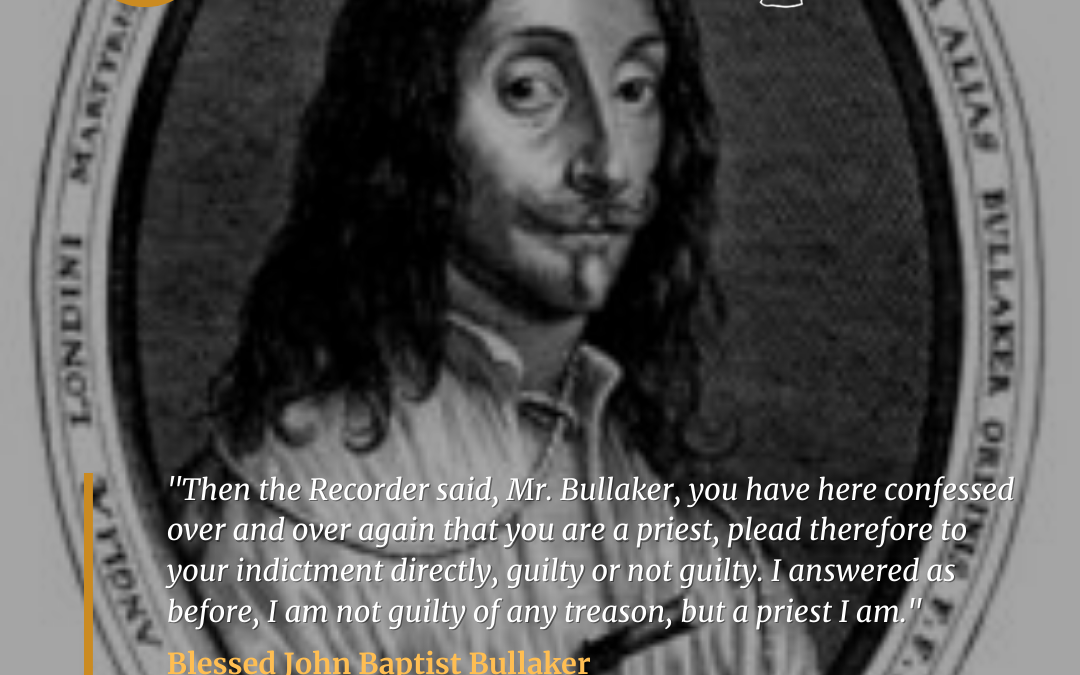
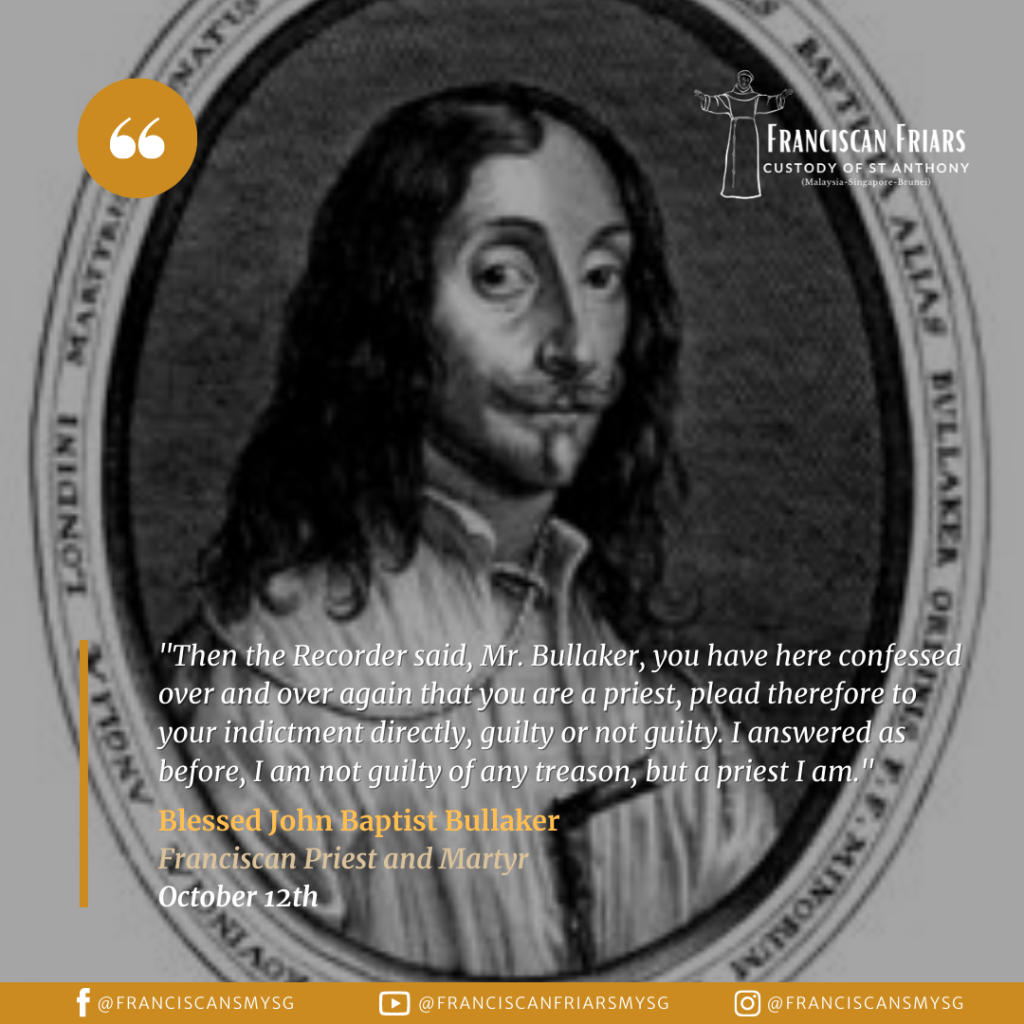
John Baptist Bullaker was born in Chichester, England. When he was eighteen, he resolved to become a missionary priest. All Catholic institutions in England at this point having been suppressed, he went to France and studied at the Jesuit College at St. Omer. The next year, he entered the Franciscans.
After his ordination in 1628, he prepared to return to England, a most dangerous mission territory. Any priest found on English soil was subject to arrest; the same was true for those who harbored him. In fact, Bullaker was arrested immediately upon his landing, though several months in jail he was released for lack of evidence. Thus, he was able to carry on a clandestine ministry for fourteen years, mostly among the gentry. Holing up in hidden cupboards, traveling in disguise, he was passed from house to house, saying Mass, hearing confessions, comforting the faithful, attending the sick and dying, while managing to evade the authorities and their watchful spies. Finally, on September 11, 1642, he was betrayed by a maid in a house where he was saying Mass, and arrested.
Asked by the sheriff his purpose in returning to England, he answered, “to bring back my country to the fold of Christ from which it was gone astray.” Tried and convicted for treason, he was sentenced to death. On October 12, he was hanged in Tyburn before a large crowd. While still alive, he was disemboweled, then quartered, his head was displayed on London Bridge.
Along with other English martyrs, he was beatified by Pope John Paul II in 1989.
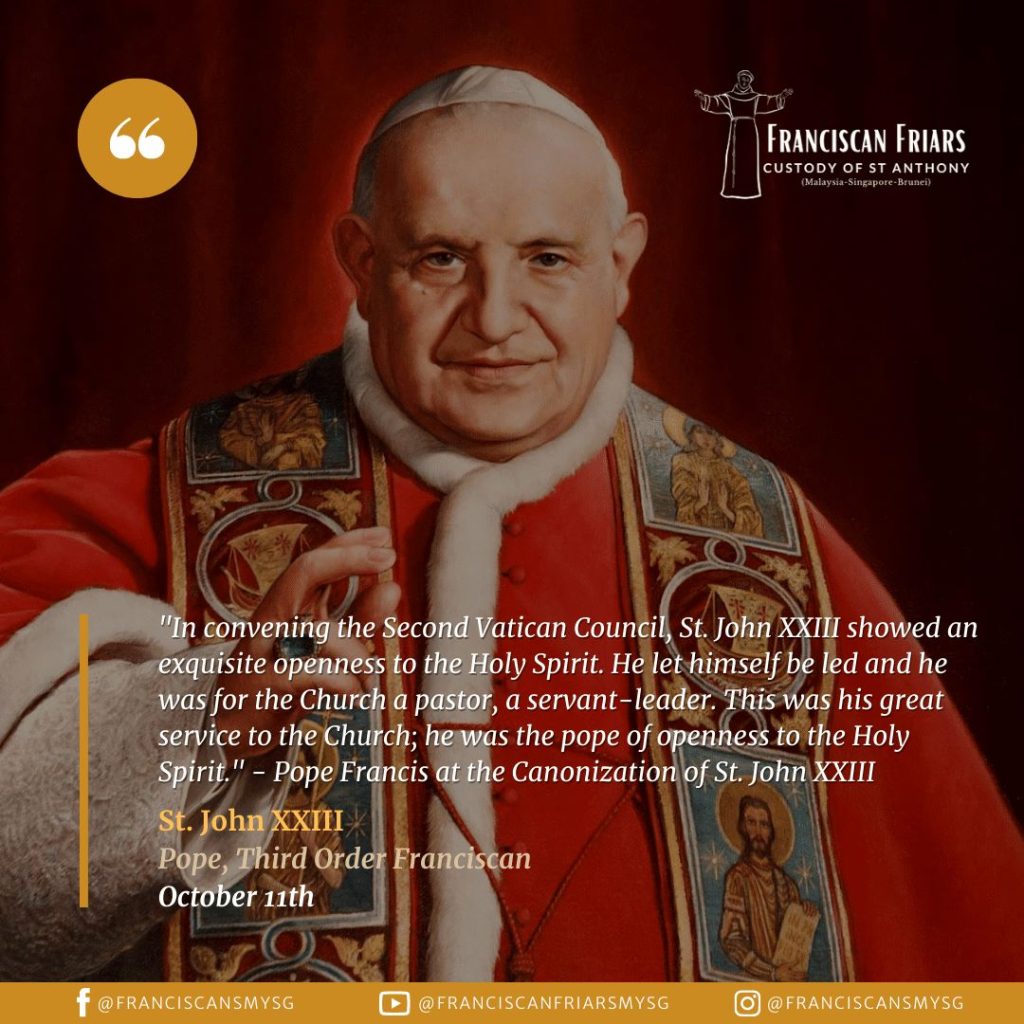
On October 28, 1958, a new pope greeted the Church from the balcony overlooking St. Peter’s Square. There stood the smiling, rotund figure of Angelo Guiseppe Roncalli, the son of peasants and recently the patriarch of Venice. “I am called John,” he said.
In appearance, and in almost every other respect, Pope John XXIII stood in contrast with his gaunt and otherworldly predecessor, Pius XII. Gregarious and open, John exuded an enthusiasm for life that in itself set a positive tone for his pontificate and raised hopes for a season of change. These hopes were answered by the astonishing announcement that he intended to convene an ecumenical council, the first in almost a hundred years. He spoke of the need to “open the windows” of the Church and to let in fresh air. It was the signal of an extraordinary renewal, an era of openness and positive dialogue between the Church and the modern world.
On October 4, 1962, on the eve of the opening of the Second Vatican Council, Pope John made a rare trip outside of Rome to visit Assisi, to prayer to the Blessed Mother and St. Francis for the success of the Council. It was a reminder of his deep Franciscan roots. As a young boy of fourteen, while enrolled in the junior seminary of Bergamo, he was received as a Third Order Franciscan. “Oh! The serene and innocent joy of that coincidence,” he said. “A Franciscan tertiary and cleric on his way to the priesthood, drawn in, therefore by the same cords of simplicity, still unconscious and happy, that was to accompany us up to the blessed altar that was later to give us everything in life.”
There were many steps along the way to the Chair of St. Peter: Apostolic Visitor to Bulgaria and then Turkey, nuncio to France, and later Patriarch of Venice. But Pope John always acknowledge his familial bonds with the followers of St. Francis. In 1959, just after his election as pope, he presided over a celebration marking the 750th anniversary of Pope Innocent III’s approval of the Franciscan Rule. At the end of his remarks, he said, “Beloved sons! Allow us to add a special word from the heart to all those here who belong to the peaceful army of the lay Tertiaries of St. Francis: I am your brother Joseph.”
Having launched Vatican II, Pope John did not live to see it completed. Dying of cancer, he retained his humor and humility. “My bags are packed,” he said, “and I am ready to go.” From his deathbed he dictated a final message of hope for the Church he loved:
Now more than ever, certainly more than in past centuries, our intention is to serve as such and not only Catholics; to defend above all and everywhere the rights of the human person and not only those of the Catholic Church; it is not the Gospel that changes; it is we who begin to understand it better…The moment has arrived when we must recognize the signs of times, seize the opportunity, and look far abroad.
Pope John XXIII died on June 3, 1963. In a few brief years he had won the hearts of the world, and his passing was universally mourned. He was canonized in April 2014.
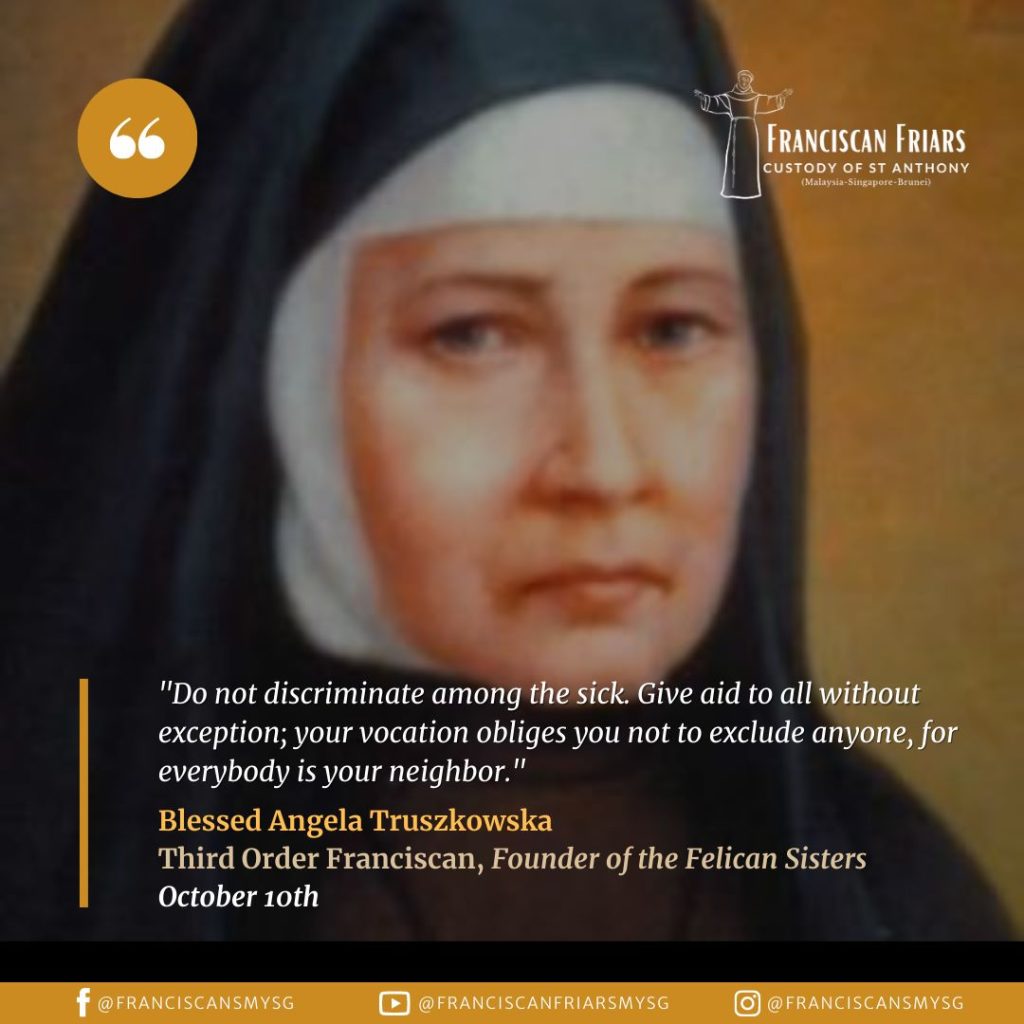
Camille Sophia Truszkowska, who later took the religious name Mother Angela, was born in Poland to an educated, middle-class family. Her father, who was a juvenile court judege, encouraged Camille’s acute social conscience and her interest in uncovering the causes of poverty and injustice. At the age of twenty-three, she underwent what she called her “conversion,” the beginning of an intense life of prayer and devotion. Though she considered entering a contemplative order, she perceived that her vocation was to be of service to the suffering poor. Joining the St. Vincent de Paul Society, she spent her time visiting and befriending those on the margins. At the suggestion of her spiritual director, a Capuchin priest, she joined the Third Order of St. Francis.
In 1855, she and a companion took a vow before the icon of Our Lady, pledging themselves to the will of God in all things. This became the foundation of the Sisters of St. Felix, a name inspired by a local Franciscan shrine. The works of the congregation, the first in Poland to combine action and contemplation, were wide-ranging, involving care for orphans, social centers, and hospitals.
At the age of forty-four, Mother Angela retired from leadership and quietly devoted herself to prayer. She loved on for thirty years, much of the time suffering in poor health. Her community, meanwhile, continued to grow, even sending sisters to North America. She died on October 10, 1899. She was beatified by Pope John Paul II in 1993.
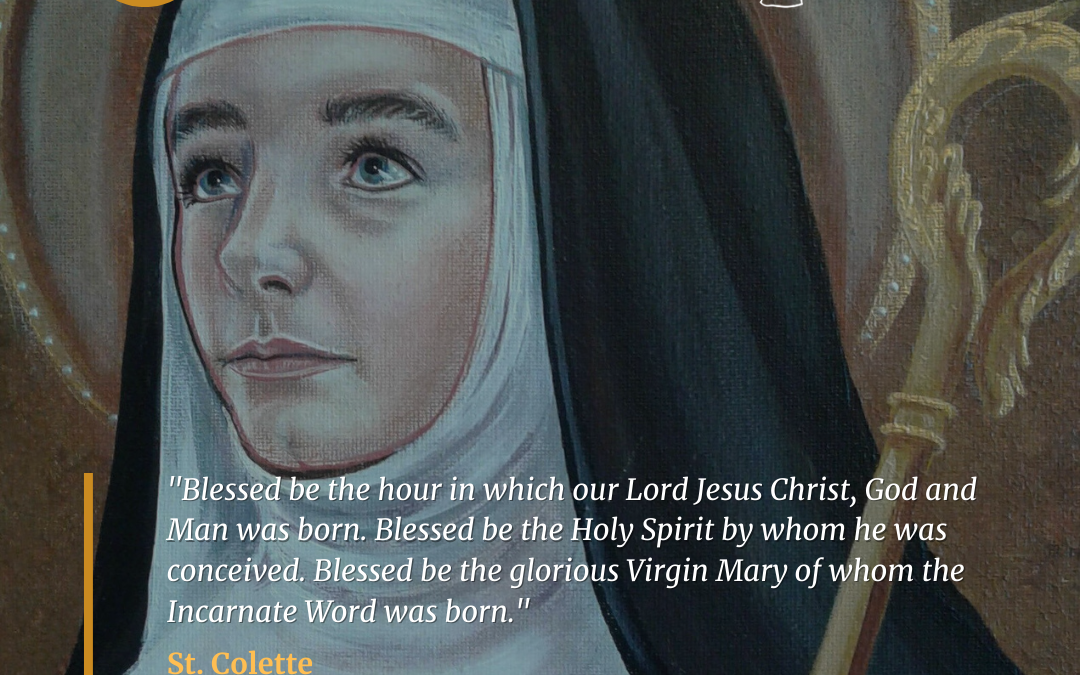
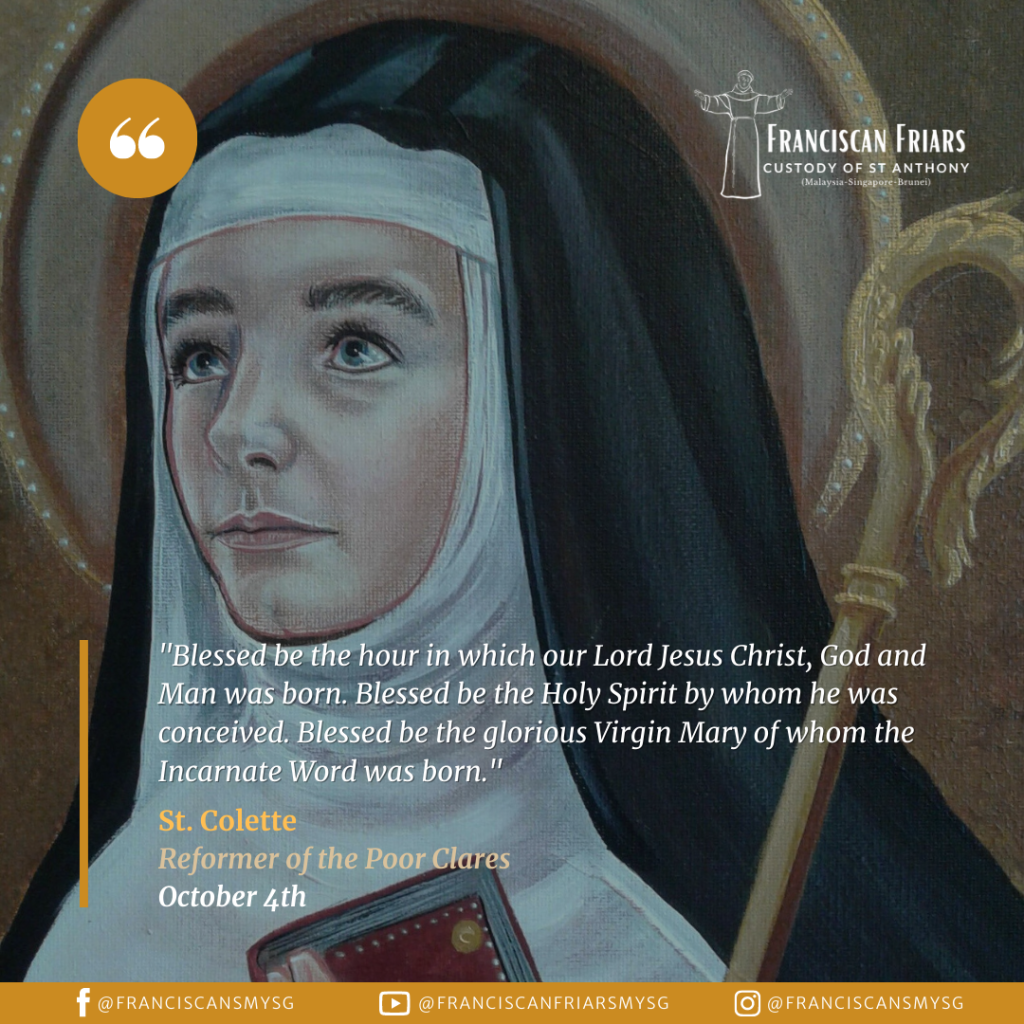
St. Colette was born to a poor family in Picardy, France. Upon the death of her parents, she was cared for by the local abbey where her father had worked. Naturally drawn to contemplative life, she became a Third Order Franciscan and afterward received permission to enter an enclosed cell attached to the church. There she spent four years in solitude and prayer, until one day, on the feast day of St. Francis, she received an extraordinary vision. She saw Francis and the Blessed Mother begging Christ to put her in charge of reforming the Franciscan Order. In an audience with Peter de Luna – recognized by the French, in this time of papal schism, as Pope Benedict XIII – he endorsed her mission and appointed her superior of any convent she might found or reform.
At once, this uneducated young maid of twenty-four set off on a tour of all the Poor Clare houses in France. She met with wide scorn and even violent opposition. In more than one case, she was accused of sorcery. Yet the tide began to turn. In all, she founded seventeen new convents and restored to many others the strict poverty of the primitive rule of St. Clare. Her reform also spread to a number of friaries, and many noble families sought her wisdom and counsel. She was sustained by a deep discipline of prayer, and every Friday she received a vision of Jesus on the cross. Like her master, St. Francis, she was drawn to animals, especially lambs and birds, which she easily tamed.