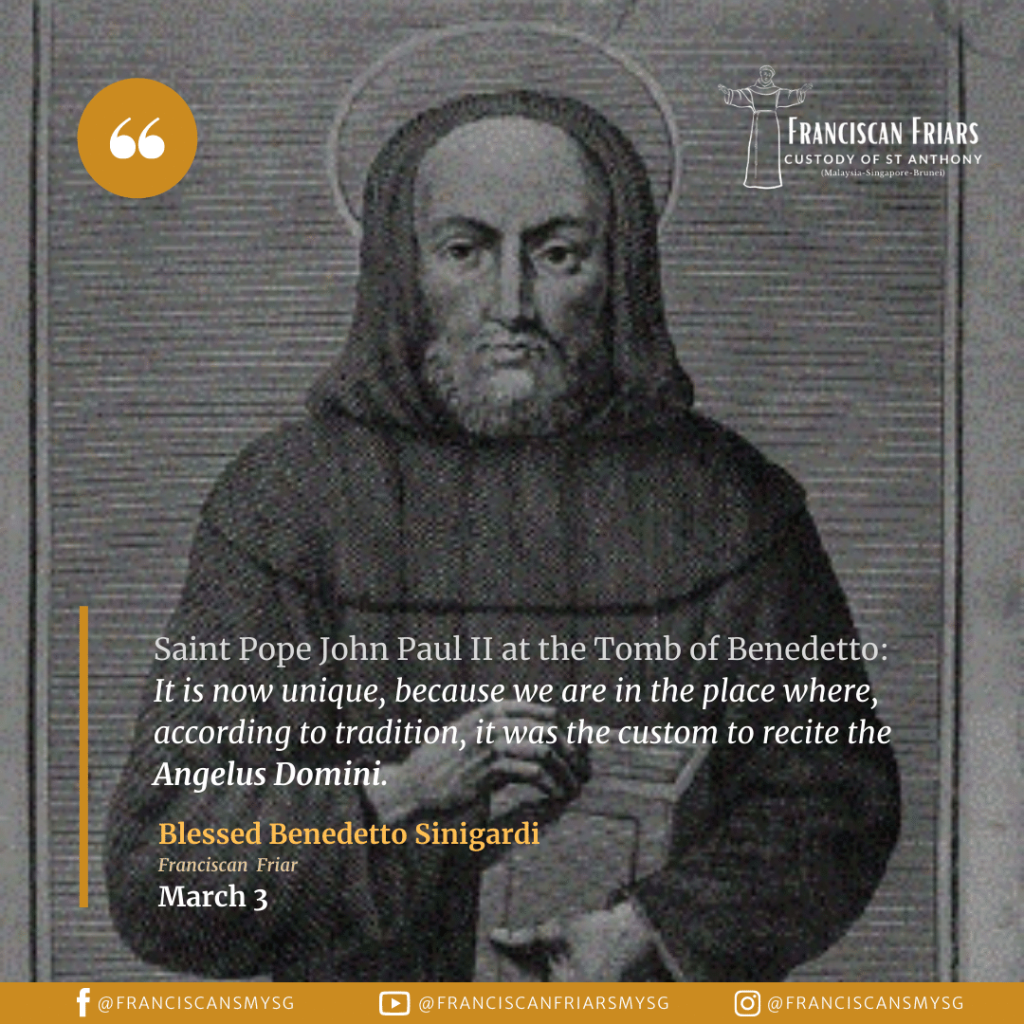
Benedict Sinigardi was born to a wealthy and noble family in Arezzo. In 1211, he heard St. Francis preach in his town, and his heart was immediately won. Abandoning his life of luxury, he was welcomed into the Order of Friars Minor, receiving his habit from St. Francis himself. At twenty-seven, he was appointed provincial of the Marche region. Afterward, he was sent on a missionary journey that took him to Greece, Romania, and Turkey. He built the first Franciscan monastery in Constantinople and then went on to the Holy Land, where he served as provincial for sixteen years. In his old age, he returned to Arezzo, where he died in 1282.
There are no surviving writings by Blessed Benedict, but he is credited with estab- lishing the Angelus Prayer, a commemoration of the Incarnation, which became one of the most popular devotions in Christendom. Deriving its name from the first words, “The Angel of the Lord declared unto Mary,” the prayer consists of the recital of three verses from Scripture with an accompanying response, interspersed by a Hail Mary. It was traditionally recited three times a day, and in many towns in Europe it is still signaled by the ringing of church bells at noon.
It is very suggestive that we stop in the middle of the day for a moment of Marian prayer. It is now unique, because we are in the place where, according to tradition, it was the custom to recite the Angelus Domini.
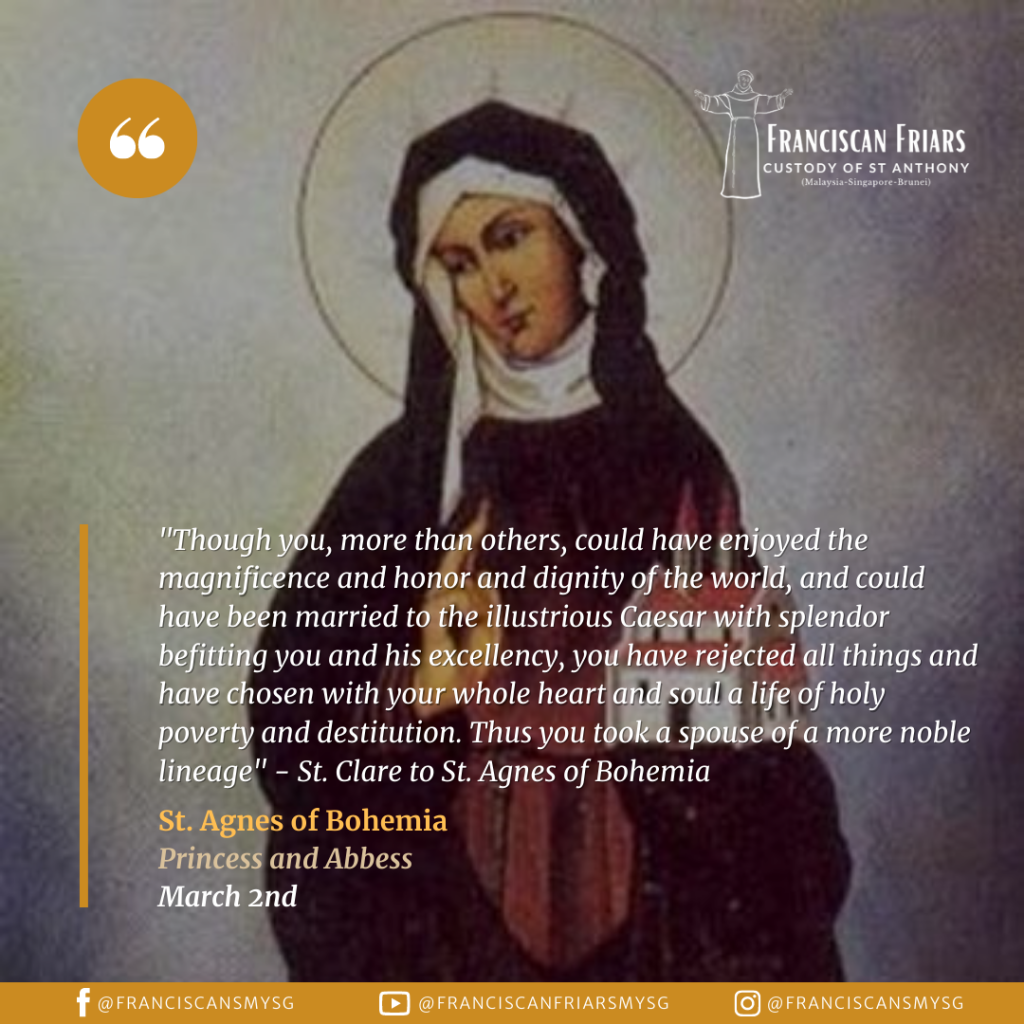
Agnes was born in Prague, where her father was the king of Bohemia. Despite the privileges of her station, she enjoyed no freedom to decide her own destiny. She was simply a commodity to be invested wherever she might bring the highest return for her family and its dynastic interests. Starting at the age of three, she was shipped to various kingdoms and betrothed to strangers she had never met. Through chance or providence, all these arrangements came to naught. Finally, when she was to be paired with King Henry III of England, she wrote to the pope asking him to prevent the marriage on the grounds that she wished to consecrate herself to Christ. Surprisingly, Henry yielded, granting, “If she had left me a for a mortal man, I should have made my vengeance and left, but I cannot take offense if she prefers the King of Heaven to me.”
What inspired this bold intention? Agnes had been deeply affected by the arrival in Prague of the first Franciscan friars, followed shortly by five Poor Clare sisters. In 1236, her royal life behind her, she formally joined them. Agnes received a number of personal letters from St. Clare, a precious window on the early Franciscan movement. Clare addressed Agnes as “the half of her soul and the special shrine of her heart’s deepest love.” Speaking as a “mother” to “her favorite daughter,” she commended Agnes for the poverty she had chosen, thus securing a place on “the path of prudent happiness.” “Place your mind before the mirror of eternity!” she counseled her. “Place your soul in the brilliance of glory! Place your heart in the figure of the divine substance! And transform your whole being into the image of the Godhead itself through contemplation.”
Agnes spent forty-four years as a Poor Clare and inspired many other noble women in Europe to follow her example. She died in 1280 and was canonized in 1989.
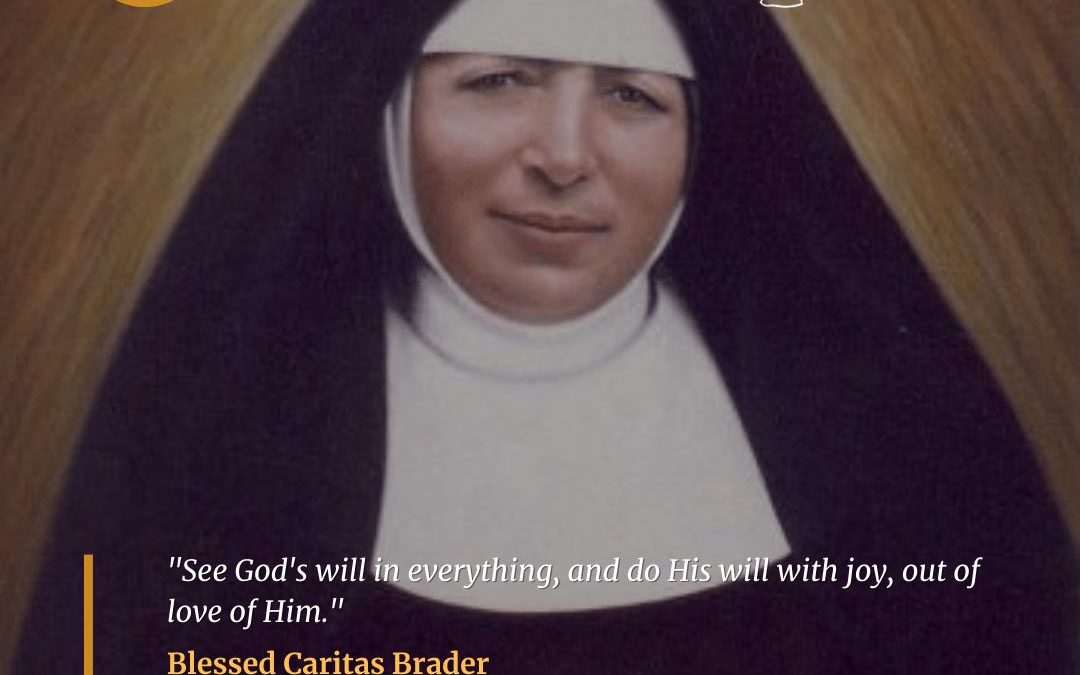
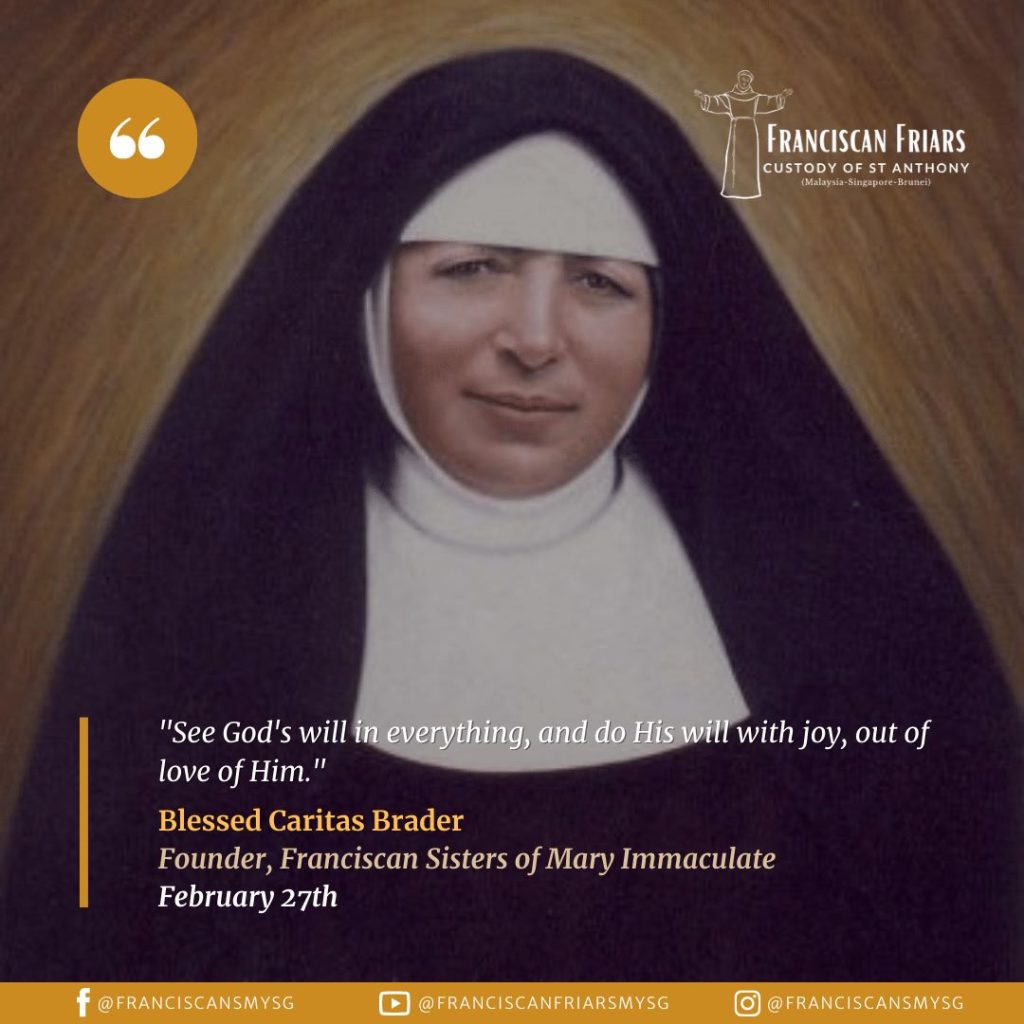
Maria Josefa Carolina Brader was born in Switzerland in 1860. At the age of twenty, she joined the cloistered Franciscan convent of Maria Hilf and took the name Sister Caritas. When a new disposition made it possible for cloistered nuns to engaged in apostolic work, she volunteered for a mission to South America. Her superior happily endorsed this plan: “Sister Caritas,” she wrote, “is supremely generous, shows no reluctance to any sacrifice, and with her extraordinary practical sense and education will be able to render great services to the mission.”
In 1893, she arrived in Tuquerres, Colombia, along with six other sisters. They operated in a vast territory that encompassed tropical jungles, coastal areas, and Andean highlands. Eventually, Sr. Caritas saw the need for a larger missionary order and received permission to found the Franciscan Sisters of Mary Immaculate, with a mission focused on education for the poor. As Superior General of the community, Mother Caritas encouraged her sisters to pursue higher education. “Do not forget,” she told them, “that the better educated, the greater the skills the educator possesses, the more she will be able to do for our holy religion and the glory of God…The more intense and visible her external activity, the deeper and more fervent her interior life must be.”
She died on February 27, 1943, by which time her congregation had spread to many countries, including the United States. She was beatified in 2003.
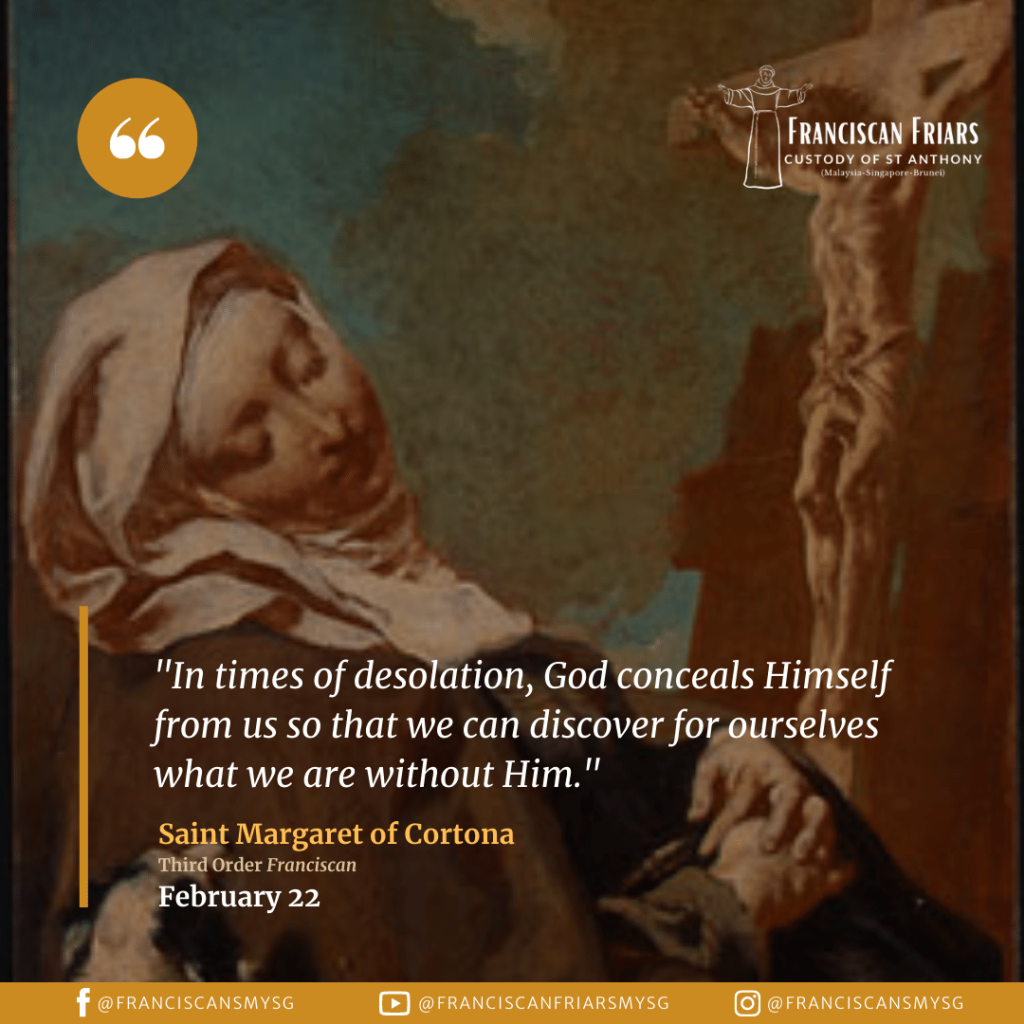
St. Margaret was raised in a poor family in Tuscany. Following the death of her mother when Margaret was just eleven, a new stepmother turned her out of the house. Eventually, with few apparent options, she eloped with a young nobleman, who kept her as his mistress. Though she bore him a son, he would not marry her. When he was eventually murdered, Margaret took this as a sign of God’s judgment on her life.
Penniless, she returned to her father’s house, but he would not take her in. Now homeless as well as destitute, she made her way to Cortona, where she had heard of the compassion of the Franciscan friars. She introduced herself by walking through town with a rope around her neck, a sign of her penitence. The friars quickly urged her to quit this spectacle and also curbed her proclivity for extremes of asceticism. Eventually she was accepted as a Franciscan tertiary. With other women she formed a nursing community, caring for the sick and the poor. Nevertheless, stories of her former life continued to generate gossip. She observed, “I see more Pharisees among Christians than surrounded Pilate.”
Over time, as reports spread of her holiness and her purported miracles, as well as her private colloquies with Christ, Margaret attracted more positive attention. The Franciscans urged her to embark on a public crusade to call sinners to conversion. Penitents from all over Italy, and as far away as France and Spain, made their way to Cortona to hear her spiritual discourses.
She died on February 22, 1297. She was canonized in 1728.
Show now that thou art converted; call others to repentance…. The graces I have bestowed on thee are not meant for thee alone.
—A message from the Lord to St. Margaret of Cortona
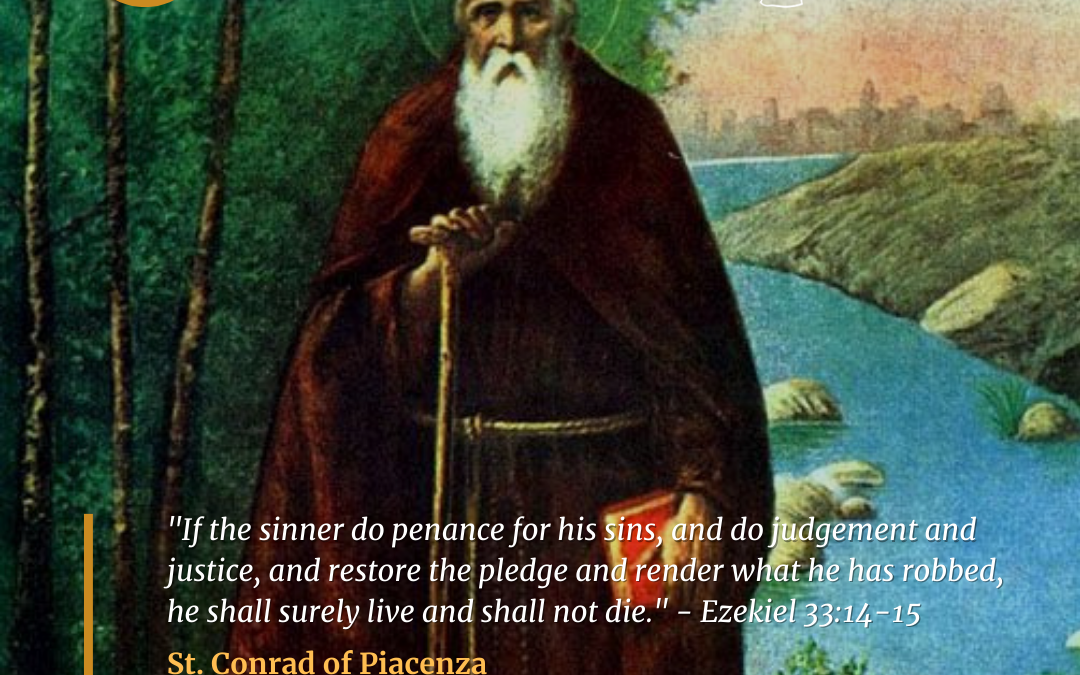
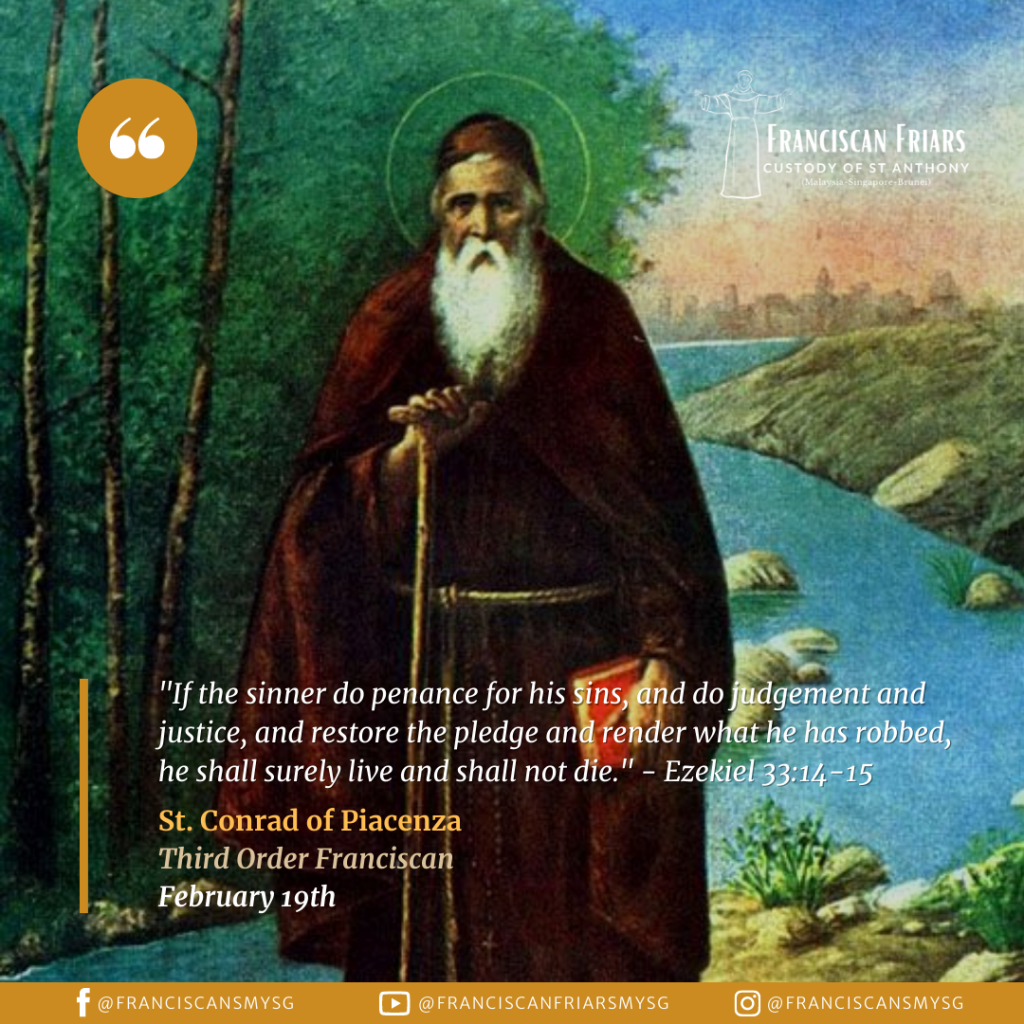
St. Conrad, a young nobleman from Piacenza, was out hunting one day when, in order to drive out his game, he ordered his servants to set fire to the surrounding brush-wood. Following a sudden turn in the wind, Conrad watched in horror as the fire consumed the neighboring fields. After returning quietly to town, he said nothing about his part in this disaster. But when a peasant was subsequently charged with the crime and sentenced to death, Conrad was filled with remorse. Stepping forward, he accepted the blame and paid for all the damages, though this left him nearly ruined. In this misfortune, however, Conrad saw the hand of God. Subsequently, he and his wife decided to give up all their property and pursue religious life. While his wife entered a convent of Poor Clares, Conrad entered the Third Order of St. Francis, joining a group of hermits in the Valley of Noto.
Contrary to his intentions, Conrad’s sacrifice caused him to be widely admired. To escape the throng of visitors, he retired to a remote grotto. But when his prayers were credited with ending a famine, he felt he had no choice but to welcome the stream of suffering pilgrims who came seeking his intervention. Many other miracles were credited to Conrad, and birds were reported to flutter over his head whenever he exited his hermitage. Discerning that his final hour had arrived, he lay on the ground in front of the crucifix and died on February 19, 1351. He was canonized in 1625.